Within Summerside
Who saw the North Bedeque object?
The North Bedeque account rests on four named witnesses, a short daylight observation, and a description too brief for certainty.
On this page
- The four named witnesses
- What they said they saw
- Why 30 seconds limits the evidence
Page outline Jump by section
Introduction
The North Bedeque sighting is one of the most frequently cited early UFO reports from Prince Edward Island, yet it is also one of the most constrained by the evidence. Reported during the first great North American “flying disc” wave of 1947, the case involved four named witnesses near Summerside who observed a bright object crossing a clear daytime sky for approximately 30 seconds. Unlike later UFO incidents that generated official files, photographs, instrument readings, or extensive witness interviews, the North Bedeque event survives primarily through contemporary newspaper reporting and later historical catalogues of the 1947 flying-disc craze. That makes the witnesses themselves the central evidence. Their identities are known, their observations were broadly consistent, and the sighting was reportedly shared rather than solitary. At the same time, the observation was brief, distant, and lacking in detail, leaving modern researchers with little basis for a confident identification. [Kirk MacDonald]kirkmcd.princeton.edubloecher 67Charles K. Gunn, animal ecologist and head of an experimental fox farm in Summerside, was.Read more…
 Within the history of UFO reports in Prince Edward Island, the case matters less because of what was seen than because of who saw it and what their testimony can—and cannot—tell us.
Who saw the North Bedeque object?
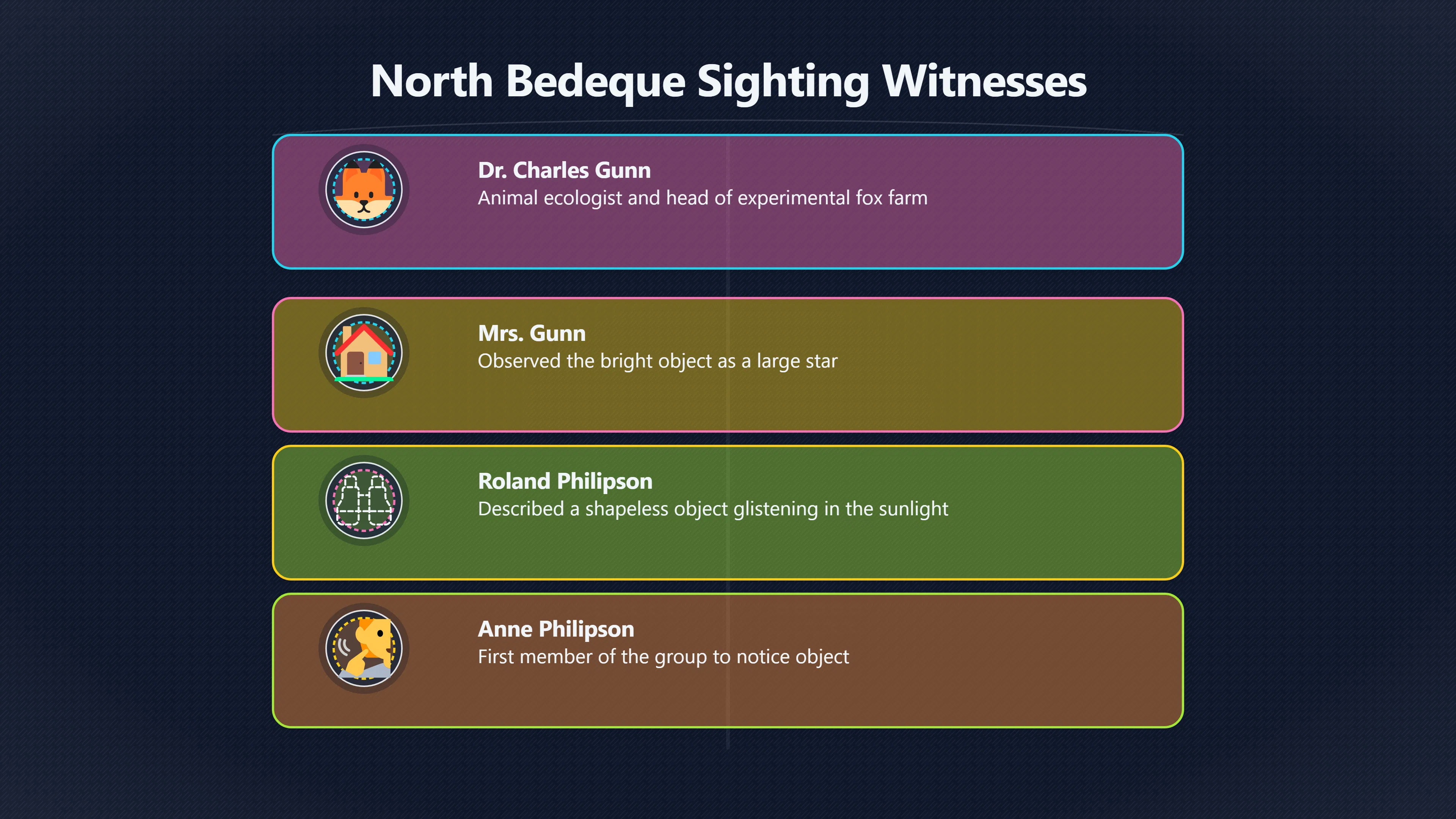
One reason the report has survived in UFO histories is that the witnesses were named rather than anonymous. Contemporary accounts identified four observers:
- Dr. Charles K. Gunn. [kirkmcd.princeton.edu]kirkmcd.princeton.edubloecher 67Charles K. Gunn, animal ecologist and head of an experimental fox farm in Summerside, was.Read more…
- Mrs. Gunn.
- Roland Philipson.
- Anne Philipson, Roland Philipson’s daughter.
Later compilations of 1947 reports preserved those names and associated them with a sighting near North Bedeque, west of Summerside, on or about 1 July 1947. The surviving record indicates that Anne Philipson was the first member of the group to notice the object. The others then looked up and observed it as well. [Kirk MacDonald]kirkmcd.princeton.edubloecher 67Charles K. Gunn, animal ecologist and head of an experimental fox farm in Summerside, was.Read more…
The presence of multiple witnesses is significant because it reduces the likelihood that the event resulted from an individual visual illusion. Four people independently looking at the same area of sky and agreeing that an unusual object was present is stronger evidence than a single-witness account. However, multiple witnesses do not automatically establish the nature of what was observed. If an object is distant and seen only briefly, several observers can still misidentify the same conventional phenomenon.
Dr. Gunn’s presence has attracted particular attention in later UFO catalogues because he was not portrayed as a casual or anonymous observer. Thomas E. Bloecher’s influential catalogue of the 1947 flying-disc wave described him as an animal ecologist and head of an experimental fox farm in Summerside. Researchers have often cited this detail as evidence that the principal witness was a professionally established local resident rather than an unidentified source. [Kirk MacDonald]kirkmcd.princeton.edubloecher 67Charles K. Gunn, animal ecologist and head of an experimental fox farm in Summerside, was.Read more…
That does not make the sighting accurate by default, but it does help explain why the report was treated seriously enough to enter later historical compilations of the 1947 wave.
What they said they saw
The descriptions preserved in newspaper accounts are remarkably brief. According to later reproductions of the original report, the witnesses described a bright object high in the sky moving rapidly toward the south. The object was said to glisten in the sunlight and was visible against a clear daytime sky. [Kirk MacDonald]kirkmcd.princeton.edubloecher 67Charles K. Gunn, animal ecologist and head of an experimental fox farm in Summerside, was.Read more…
Roland Philipson reportedly described it as a shapeless object that flashed or glistened in the sun. Mrs. Gunn compared it to a large star moving through the daytime sky. These descriptions are notable because they emphasise brightness rather than structure. None of the witnesses appears to have reported wings, a fuselage, exhaust, vapour trails, rotating components, or any other feature that would clearly identify a conventional aircraft. Nor did they provide a detailed geometric description such as a disc, sphere, cylinder, triangle, or oval. [Kirk MacDonald]kirkmcd.princeton.edubloecher 67Charles K. Gunn, animal ecologist and head of an experimental fox farm in Summerside, was.Read more…
The lack of shape information is one of the defining characteristics of the case. Although the event became associated with the flying-disc wave sweeping North America, the witnesses themselves seem to have described a luminous object rather than a clearly disc-shaped craft. This distinction matters because many reports from the summer of 1947 were quickly labelled “flying saucers” by newspapers even when witness descriptions were much less specific.
The object was also reportedly silent. Given the apparent altitude suggested by the witnesses, silence alone tells researchers very little. An aircraft at substantial distance can easily appear silent, especially if atmospheric conditions reduce the audibility of engine noise. Likewise, balloons, reflective debris, and certain astronomical phenomena would not produce audible sound at the observer’s location.
Why the 30-second duration matters
The most important limitation of the North Bedeque case is the reported duration: approximately 30 seconds. [Kirk MacDonald]kirkmcd.princeton.edubloecher 67Charles K. Gunn, animal ecologist and head of an experimental fox farm in Summerside, was.Read more…
At first glance, half a minute may seem like a substantial observation. In practical terms, however, it is a very short period for identifying a distant object in the sky. During those thirty seconds the witnesses had to notice the object, attract one another’s attention, look up, assess what they were seeing, and watch it move away.
For investigators, short-duration sightings create several problems:
- There is little opportunity to study shape or structure.
- Estimating speed becomes difficult because distance is unknown.
- Estimating size becomes impossible without a reliable range.
- Direction of travel may be misjudged if the object is extremely distant.
- Witnesses often remember the most striking feature—brightness—rather than finer details.
These limitations are visible throughout the North Bedeque account. The surviving descriptions focus on brightness, motion, and the fact that the object seemed unusual. They provide almost no information about dimensions, altitude, shape, colour changes, or manoeuvres. [Kirk MacDonald]kirkmcd.princeton.edubloecher 67Charles K. Gunn, animal ecologist and head of an experimental fox farm in Summerside, was.Read more…
As a result, modern researchers cannot calculate meaningful performance characteristics. A small nearby object and a large distant object can produce very similar visual impressions. Without reliable distance estimates, claims about extraordinary speed remain speculative.
What can be inferred from the witness testimony?
Despite the limitations, the testimony does allow a few cautious observations.
First, the witnesses appear to have agreed on the broad facts. Available accounts do not preserve significant contradictions among the four observers. All reportedly saw a bright object, high in the sky, moving rapidly and remaining visible for only a short period. [Kirk MacDonald]kirkmcd.princeton.edubloecher 67Charles K. Gunn, animal ecologist and head of an experimental fox farm in Summerside, was.Read more…
Second, the object seems to have been observed in good weather conditions. The reports describe a clear sky and bright sunlight. That reduces the likelihood that the witnesses were merely observing a cloud formation or weather-related obscuration. However, clear skies can also enhance reflections from aircraft, balloons, or other airborne objects.
Third, the witnesses did not report extraordinary behaviour beyond apparent speed. The object did not reportedly hover, reverse direction, accelerate dramatically, change shape, land, or interact with the environment. Instead, it moved steadily away toward the south. Later catalogues describe the movement as a straight and level course. [Kirk MacDonald]kirkmcd.princeton.edubloecher 67Charles K. Gunn, animal ecologist and head of an experimental fox farm in Summerside, was.Read more…
That places the case in a category common during the 1947 flying-disc wave: brief daylight observations of bright aerial objects whose appearance was unusual but whose behaviour was not obviously impossible.
Why no firm identification has emerged
No official explanation appears to have been attached to the case in the major 1947 sighting catalogues. Bloecher’s catalogue lists the Summerside report but does not provide a resolved identification. Later tables derived from the same body of material likewise preserve the case without assigning a definitive cause. [Kirk MacDonald]kirkmcd.princeton.edubloecher 67Charles K. Gunn, animal ecologist and head of an experimental fox farm in Summerside, was.Read more…
It is important not to overstate what that means. An absence of explanation is not evidence that the object was extraordinary. In many early UFO cases, investigators simply lacked enough information to reach any conclusion.
Several conventional possibilities remain plausible:
- Sunlight reflecting from a distant aircraft.
- A high-altitude balloon.
- A meteor or other transient atmospheric phenomenon.
- Misperception of an ordinary object viewed under unusual lighting conditions.
The surviving record does not contain enough detail to eliminate these possibilities individually. At the same time, it does not provide enough information to support more exotic interpretations.
This ambiguity is precisely why the case has endured. It is neither solved nor especially strong. Instead, it occupies the large middle ground that characterises many early UFO reports: sincere witnesses, a real observation, and insufficient information for certainty.
What the witnesses contribute to Prince Edward Island UFO history
The enduring value of the North Bedeque sighting lies in its witness record rather than its evidential strength. Because the observers were named and because the report emerged during the opening days of the 1947 flying-disc craze, the case provides a rare glimpse of how Prince Edward Island entered the wider North American saucer story. [Kirk MacDonald]kirkmcd.princeton.edubloecher 67Charles K. Gunn, animal ecologist and head of an experimental fox farm in Summerside, was.Read more…
The four witnesses did not claim a landing, contact experience, or dramatic encounter. They reported a bright object crossing the sky for about half a minute and disappearing from view. That modest claim is precisely why the case remains useful to historians. It reflects the type of report that dominated the summer of 1947: ordinary people observing something unexpected in the sky and trying to describe it using the limited vocabulary available before modern UFO culture had fully developed.
Viewed narrowly as evidence for an unidentified aerial phenomenon, the case is weak. Viewed as a historical record of how the flying-disc wave reached Prince Edward Island, it is one of the province’s most important early witness accounts. The names of Dr. and Mrs. Gunn, Roland Philipson, and Anne Philipson remain the core of that story because, after nearly eight decades, their brief 30-second observation is still the only substantial evidence the case possesses. [Kirk MacDonald]kirkmcd.princeton.edubloecher 67Charles K. Gunn, animal ecologist and head of an experimental fox farm in Summerside, was.Read more…
Amazon book picks
Further Reading
Books and field guides related to Who saw the North Bedeque object?. Use these as the next step if you want deeper reading beyond the article.

The UFO Encyclopedia, 3rd Ed.
Useful for comparing North Bedeque with other early UFO reports and case-record limits.
Flying Saucers over America
Places the brief Prince Edward Island sighting inside the same first flying-disc panic.
The UFO Encyclopedia
Useful for comparing North Bedeque with other early UFO reports and case-record limits.
The Flying Saucers Are Real
Reflects the early interpretive culture that grew out of the first flying-disc reports.
eBay marketplace picks
Marketplace Samples
Example marketplace items related to this page. Use the search link to explore similar finds on eBay.

Endnotes
-
Source: kirkmcd.princeton.edu
Title: bloecher 67
Link: https://kirkmcd.princeton.edu/JEMcDonald/bloecher_67.pdfSource snippet
Charles K. Gunn, animal ecologist and head of an experimental fox farm in Summerside, was.Read more...
-
Source: recherche-collection-search.bac-lac.gc.ca
Link: https://recherche-collection-search.bac-lac.gc.ca/eng/Home/Record?IdNumber=239747&app=pffwwSource snippet
bac-lac.gc.ca239747 - Collection searchNo information is available for this page...
-
Source: journal.lib.uoguelph.ca
Link: https://journal.lib.uoguelph.ca/index.php/perj/article/view/933/1504Source snippet
Helen Gordon Stewart in the now-legendary Fraser Valley Library Demonstration Project funded by the Carnegie Corporation. In...Read...
Additional References
-
Source: archive.org
Link: https://archive.org/stream/langstaffsoftees00long/langstaffsoftees00long_djvu.txtSource snippet
See other formats. PRESENTED Cbc loiml.Institution of ©rent Britain BY R. LONGSTAFF...Read more...
-
Source: culturesummerside.com
Link: https://www.culturesummerside.com/microfilmSource snippet
MicrofilmMaster Name Index. This unique index is a collection of over 400,000 index cards bearing genealogical data on thousands of Princ...
-
Source: archive.org
Link: https://archive.org/stream/archaeologiaael13unkngoog/archaeologiaael13unkngoog_djvu.txtSource snippet
Full text of "Archaeologia aeliana, or, Miscellaneous tracts...Full text of "Archaeologia aeliana, or, Miscellaneous tracts relating to...
-
Source: archive.org
Link: https://archive.org/stream/yearbookandreco02britgoog/yearbookandreco02britgoog_djvu.txtSource snippet
erved for generations on library shelves before it was...Read more...
-
Source: collections.mun.ca
Link: https://collections.mun.ca/digital/collection/wwiartifact/id/7961/Source snippet
experience full interactivity, please enable Javascript in your browser...
-
Source: publicsafety.gc.ca
Link: https://www.publicsafety.gc.ca/lbrr/archives/rcmp-rrcmp-1947-eng.pdfSource snippet
ice for the year ended March 31, 1947.. Respectfully...Read more...
Published: March 31, 1947
-
Source: archive.org
Link: https://archive.org/stream/proceedings00sociuoft/proceedings00sociuoft_djvu.txtSource snippet
UARIES in NEWCASTLE-UPON-TYNE. THIRD SERIES.Read more...
-
Source: archive.org
Link: https://www.archive.org/stream/s3proceedings03sociuoft/s3proceedings03sociuoft_djvu.txtSource snippet
comes into view, from behind a massive...Read more...
-
Source: youtube.com
Link: http://www.youtube.com/watch?v=z25NfZ0Ea9cSource snippet
UFO Prince Edward Island UFO over Charlottetown, Prince Edward Island, Canada...
-
Source: archive.org
Title: The Bewick collector
Link: https://archive.org/download/cu31924032505442/cu31924032505442.pdfSource snippet
A descriptive catalogue of the works...Three objects hav^been specially before me in the composition of the following pages, — the first...
Topic Tree