Within Alberta UFOs
How Aviation Shapes Alberta UFO Reports
CFB Cold Lake, military training and busy flight corridors make Alberta a province where unusual sky reports need aviation context.
On this page
- Why Cold Lake matters to Alberta sightings
- Military aircraft, routes and controlled airspace
- Where aviation explanations fit and fall short
Page outline Jump by section
Introduction
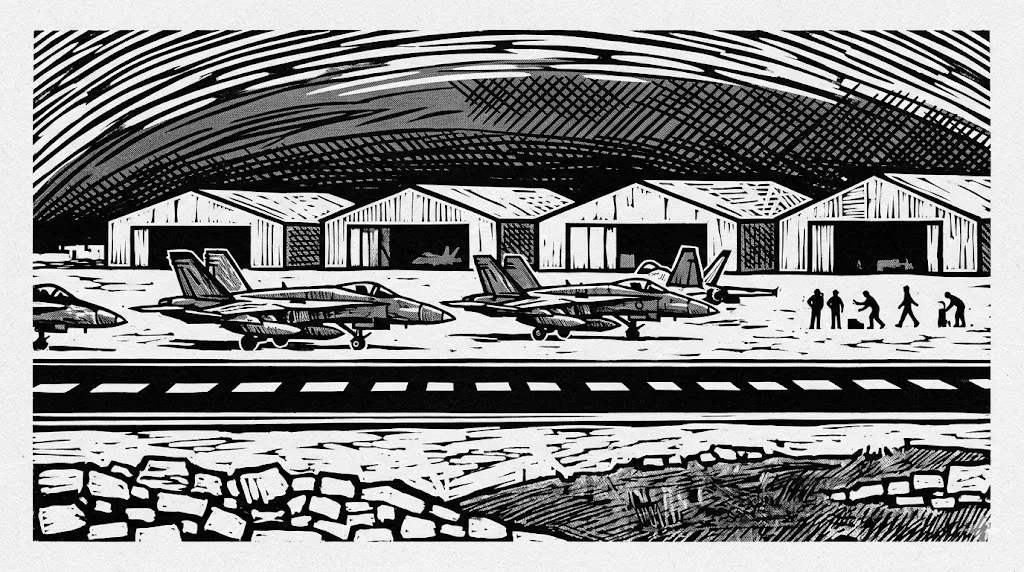
Cold Lake matters to Alberta UFO history because it is one of the places where an unusual light in the sky may have a very ordinary but highly specialised aviation explanation. CFB Cold Lake, home of 4 Wing, is not just a local airfield: it is a major Royal Canadian Air Force fighter base, a training centre for Canadian and allied crews, and the gateway to the Cold Lake Air Weapons Range, a vast restricted training area north of the city. That does not mean every Alberta report near Cold Lake can be dismissed as “just jets”. It means the first serious question is usually aviation-shaped: what aircraft, exercise, airspace, radar system, weather condition or viewing angle might have produced the sighting? The value of Cold Lake in Alberta’s UFO record is therefore less about one dramatic proof case and more about a recurring interpretive problem: a busy military sky can make real aircraft activity look strange from the ground, while also creating a setting where a genuinely unresolved report deserves careful handling.
Why Cold Lake changes the way Alberta sightings should be read
For much of Alberta, a UFO report begins with a witness seeing a light, object, formation or sound against a wide prairie or northern sky. Around Cold Lake, that same report starts inside a denser aviation environment. The official Royal Canadian Air Force page for 4 Wing says the base is located at CFB Cold Lake in Alberta, operates under 1 Canadian Air Division, hosts tactical fighter training for Canadian and international personnel, and has an “almost unrestricted” air weapons range of 1.17 million hectares with modern threats and targets. Its listed aircraft include CF-188 Hornets and CH-146 Griffons, with multiple fighter and training squadrons based at Cold Lake. [Canada]canada.ca4 Wing Cold Lake4 Wing Cold Lake - Canada.ca…
That local fact changes the evidential balance. A fast light, a sudden rumble, a formation of points, a flare-like glow, a sharp turn, or a sound arriving after the visible object has moved can be far less mysterious near a fighter training base than it would be in a quiet region with little air traffic. The City of Cold Lake describes 4 Wing as the largest and busiest fighter aircraft wing of the Canadian Armed Forces and says it participates in the NORAD mission around the clock. It also places the Cold Lake Air Weapons Range roughly 30 kilometres north of the city and describes it as a 12,000 square kilometre tract of unrestricted airspace used for pilot training. [City of Cold Lake]coldlake.comCity of Cold Lake4 Wing Cold LakeFor over seven decades, Cold Lake has been the proud home of 4 Wing, the largest and busiest fighter air…
This is why Cold Lake should be treated as an aviation-context page within Alberta’s UFO history, not as a simple catalogue of “military UFOs”. The military setting does not automatically make sightings more exotic. In many cases it makes aircraft, training activity, radar procedures and restricted airspace more relevant explanations. It also means that a good case assessment should ask whether the report coincided with known training periods, temporary airspace activity, exercises, public service announcements, sonic booms, unusual manoeuvres, or aircraft types not familiar to casual observers.
The range makes ordinary flight look unusual
The Cold Lake Air Weapons Range is the main reason the area repeatedly attracts attention in sky reports. RCAF background material for Exercise Maple Flag describes the range as part of a much larger group of airspaces that includes an air combat manoeuvring area and a low-level flying area, all controlled and managed by 4 Wing’s Operational Support Squadron. The same backgrounder says the wider airspace group spans from British Columbia to Manitoba and from the Northwest Territories to central Alberta, while the Cold Lake range itself is 1.17 million hectares and contains more than 90 target complexes and over 640 individual targets. [Canada]canada.caExercise Maple FlagExercise Maple Flag - Backgrounder - Royal Canadian Air Force - Canada.ca…
That scale matters for UFO interpretation. A person on the ground does not see “airspace management”; they see lights, movement, noise and sometimes sudden silence. A training sortie can involve aircraft at different heights, aircraft turning hard, aircraft using lights in ways that look odd from certain angles, and aircraft appearing to hover or change speed because the viewer lacks distance cues. At night, a fighter approaching head-on may look like a stationary bright object, then suddenly seem to accelerate when it turns. In haze, smoke, snow, cloud gaps or aurora-lit conditions, a known aircraft can become visually ambiguous.
Maple Flag illustrates this especially well. The RCAF describes the exercise as realistic training for modern air operations, involving command and control, air-to-air and air-to-surface weapons and tactics, and air-to-air refuelling, primarily inside the Cold Lake Air Weapons Range. Past participants have included Canadian and international aircrew from countries such as Australia, Belgium, France, Germany, the Netherlands, New Zealand, Singapore, the United Kingdom and the United States. [Canada]canada.caExercise Maple FlagExercise Maple Flag - Backgrounder - Royal Canadian Air Force - Canada.ca… In a later Maple Flag 51 backgrounder, the RCAF listed CF-188 Hornets, contracted Alpha Jets in an opposing-force role, Hercules and Polaris tankers, NATO airborne warning and control aircraft, B-52 bombers, EA-18G Growlers, F-16s and ground-based radar services among the participating elements. [Canada]canada.caExercise MAPLE FLAG 51Exercise MAPLE FLAG 51 - Backgrounder - Royal Canadian Air Force - Canada.ca…
For a UFO reader, the takeaway is straightforward: Cold Lake can put unusual-looking aircraft combinations into the Alberta sky. Not all of these would be obvious to a witness standing at a lake, road, farm, campsite or community edge. A tanker track, a high aircraft glinting in sunlight, an electronic-warfare jet, an aggressor aircraft, a low-level fighter, a flare, or a distant formation can produce a sighting that feels extraordinary before it is placed back into its operational setting.
Sonic booms, delayed sound and the “something overhead” problem
Cold Lake also shows why sound can confuse rather than clarify a sky report. A loud boom, rumble or window-rattle may be remembered as part of a UFO event even if the source is a normal aircraft doing authorised training. In August 2022, local reporting said National Defence confirmed that a loud noise heard around Cold Lake was a sonic boom from a CF-18 Hornet training in the Cold Lake Air Weapons Range. The report said the aircraft was within restricted airspace, had approval for supersonic flight, and that atmospheric conditions can sometimes carry sonic booms farther than usual. [St. Albert Gazette]stalbertgazette.comSt. Albert GazetteNational Defence confirms loud noise in Northern Alberta was sonic boom - St. Albert News…
That kind of incident is useful because it gives a concrete, documented example of “sky confusion” without requiring a UFO claim at all. People heard something powerful, sudden and unexplained in the moment. The explanation was not a meteor, explosion or unknown craft, but military aviation under controlled conditions. Similar logic can apply to some reports of lights followed by sound. Sound travels far more slowly than light, and fighter aircraft can move quickly enough that the sound seems disconnected from the visible object. Terrain, temperature layers and wind can also affect where the noise is heard most clearly.
This does not mean every boom or rumble near Cold Lake is automatically identified. The point is more careful: in this part of Alberta, a credible witness can be honestly surprised by a real aircraft event, especially when the flight itself is distant, hidden by cloud, visible only briefly, or not visible at all. The correct response is not ridicule; it is checking time, direction, weather, NOTAMs, local military notices, and any later statement from National Defence or civil aviation authorities.
Controlled airspace is evidence context, not a mystery shortcut
Cold Lake’s aviation environment is not frozen in the past. NAV CANADA’s 2026 Cold Lake Airspace Terms of Reference says an aeronautical study was initiated to review airspace requirements north-east of Cold Lake Airport. It says the study area concerns northern Alberta, Saskatchewan, Manitoba, the southern Northwest Territories and Nunavut after the Department of National Defence advised of a requirement for military training airspace near Cold Lake. The document describes the Cold Lake Military Terminal Control Area as surrounding Cold Lake/Group Captain R.W. McNair Airport and serving as the south-west corner of a proposed airspace approximately 460 nautical miles by 380 nautical miles, extending north into the Northwest Territories and east into Manitoba. [NAV CANADA]navcanada.caNAV CANADACold Lake Airspace Terms of ReferenceNAV CANADACold Lake Airspace Terms of Reference [NAV CANADA]navcanada.caNAV CANADACold Lake Airspace Terms of ReferenceNAV CANADACold Lake Airspace Terms of Reference
For UFO analysis, this is important because it shows Cold Lake is not merely a town with a base nearby. It is a node in a large, managed aviation system. Reports from this region may involve military terminal control areas, range boundaries, cross-provincial airspace, aircraft routing, training requirements, and civilian-military coordination. The same NAV CANADA document says the study would assess stakeholder requirements, concerns, hazards and possible mitigations, and coordinate with Transport Canada. [NAV CANADA]navcanada.caNAV CANADACold Lake Airspace Terms of ReferenceNAV CANADACold Lake Airspace Terms of Reference
This kind of airspace paperwork is not glamorous, but it is exactly what helps separate weak UFO claims from better ones. A report that ignores controlled airspace and active training routes is incomplete. A report that documents the time, viewing direction, elevation, apparent movement, duration, sound, weather, nearby aviation notices and possible aircraft activity is much more useful. Around Cold Lake, the aviation setting should be treated as a baseline condition, not an afterthought.
Where official reporting fits
Canadian UFO reporting is fragmented, and Cold Lake sits at the point where several systems can overlap. The Office of the Chief Science Advisor’s Sky Canada material notes that unidentified aerial phenomena in Canada can be reported through multiple channels. At the federal level, Transport Canada maintains CADORS, the Civil Aviation Daily Occurrence Reporting System, for incidents affecting aviation safety, including UAP sightings; the RCAF and Department of National Defence may also receive reports through operational networks; and law enforcement or civil society groups may receive public reports. [Science.gc.ca]science.gc.caManagement of Public Reporting of Unidentified Aerial Phenomena in CanadaManagement of Public Reporting of Unidentified Aerial Phenomena in Canada
CADORS is especially relevant because it is not a UFO-belief database. Transport Canada explains that CADORS was launched in 1985 to provide timely information about civil aviation occurrences and that it is used to capture information air traffic service providers must report under Canadian Aviation Regulations. Transport Canada says it receives an average of about 16,750 aviation incident and accident reports annually, and that NAV CANADA supplies about 80 per cent of the aviation occurrence information used to create CADORS records. [Transport Canada]tc.canada.caTransport Canada The Civil Aviation Daily Occurrence Reporting System (CADORSTransport Canada The Civil Aviation Daily Occurrence Reporting System (CADORS
That gives Alberta readers a useful distinction. A Cold Lake-area light reported by a member of the public to a UFO group is one kind of evidence. A pilot or air traffic report in an aviation safety system is another. Neither automatically proves an unknown craft, but the latter may preserve details such as time, location, altitude, aircraft callsigns, pilot observations and operational context. When a Cold Lake story appears in later UFO writing, the first question should be whether it has a traceable aviation or archival record, not just whether it sounds dramatic.
The 1981 Cold Lake report and its limits
One Cold Lake case often cited in modern discussion comes from historic Canadian military and National Research Council material. Vice reported in 2021 that unclassified Canadian records include a 14 September 1981 incident at CFB Cold Lake in which a lit object reportedly flew through the base’s restricted area at about 6,000 feet without being picked up on radar. [VICE]vice.comThe Canadian Military Has Been Encountering UFOs for Decades, Documents ShowThe Canadian Military Has Been Encountering UFOs for Decades, Documents Show…
That is the sort of detail that makes a case interesting: a military location, restricted airspace, a reported object, an approximate altitude and a claimed lack of radar detection. But the same features also demand caution. A secondary article is not the same as a full case file, radar tape, witness interview set, weather reconstruction and operational timeline. “Not picked up on radar” can mean several things, depending on equipment, range, altitude, clutter, operator attention, transponder expectations and the precise wording of the original record. It should not be inflated into proof that a craft defeated military tracking.
The best reading is that the 1981 Cold Lake report is a historically notable military-linked Alberta UFO item, but not a stand-alone proof case. It belongs in the same analytical lane as other Canadian Cold War-era military sightings: worth preserving, worth checking against original records, and worth comparing with aviation activity, but not strong enough on its own to settle the question of what was seen. The Cold Lake setting makes the report more operationally interesting, yet it also increases the number of possible military aviation explanations that must be considered.
Where aviation explanations fit and where they fall short
Aviation explanations are strongest when a sighting matches known flight patterns, training periods or aircraft behaviour. Near Cold Lake, that can include CF-188 Hornets, helicopters, tankers, allied exercise aircraft, contracted adversary aircraft, radar training, air-to-air refuelling, low-level routes, live-fire or inert weapons training, and publicised surges in military activity. The RCAF’s own Maple Flag material confirms that Cold Lake exercises can include complex packages of fighters, electronic warfare aircraft, tankers, airborne warning aircraft and ground radar support. [Canada]canada.caExercise MAPLE FLAG 51Exercise MAPLE FLAG 51 - Backgrounder - Royal Canadian Air Force - Canada.ca…
They are weaker when the timing, location, movement or physical effects do not fit aircraft activity; when multiple independent witnesses describe the same unusual object from different positions; when an aviation authority or military source cannot correlate the report after checking; or when there is a preserved official record with enough detail to rule out ordinary traffic. Even then, “unexplained” should be read literally. It means the available information did not settle the matter, not that an extraordinary cause has been demonstrated.
Cold Lake therefore gives Alberta UFO history one of its most useful sceptical tools: not a dismissive slogan, but a structured first pass. Ask what was flying, what airspace was active, what exercises were scheduled, what weather or atmospheric conditions existed, whether sound timing made sense, and whether any aviation safety record exists. If those checks explain the report, the case becomes part of Alberta’s sky-confusion pattern. If they do not, the case becomes more interesting, but still needs careful evidence rather than assumption.
What Cold Lake adds to Alberta’s wider UFO story
Alberta’s better-known UFO landmarks, such as the Duhamel landing-marks case and the St. Paul UFO Landing Pad, pull the province’s history in two different directions: physical-trace investigation on one side, public culture and tourism on the other. Cold Lake adds a third lane: aviation interpretation. It reminds readers that Alberta’s UFO record is shaped not only by witnesses and folklore, but also by military infrastructure, controlled airspace, official reporting systems and the practical difficulty of judging distance and motion in a big sky.
That makes Cold Lake less sensational than some readers might expect, but more useful. It is the place in the Alberta story where a strange report should first be put beside fighter training, range activity, radar coverage, air traffic reporting and known military exercises. Sometimes that will make a mystery smaller. Sometimes it will leave a report unresolved. Either outcome is valuable, because it moves the discussion away from reflexive belief or reflexive debunking and towards the question that matters most in serious UFO history: what does the available evidence actually allow us to say?
Amazon book picks
Further Reading
Books and field guides related to How Aviation Shapes Alberta UFO Reports. Use these as the next step if you want deeper reading beyond the article.
The UFO Experience
Examines sighting classifications and the challenge of separating ordinary aerial phenomena from unexplained reports.
UFOs
Focuses heavily on pilot, military, radar, and aviation-related UFO cases that mirror the article's aviation-first approach.
Skunk Works
Provides context for how advanced military aircraft and secret flight programs can influence unusual aerial sightings.
The Hunt for Zero Point
Explores the overlap between classified aerospace projects and reports of unusual objects in the sky.
eBay marketplace picks
Marketplace Samples
Example marketplace items related to this page. Use the search link to explore similar finds on eBay.

Endnotes
-
Source: canada.ca
Title: 4 Wing Cold Lake
Link: https://www.canada.ca/en/air-force/corporate/who-we-are/organizational-structure/1-canadian-air-division/4-wing.htmlSource snippet
4 Wing Cold Lake - Canada.ca...
-
Source: canada.ca
Title: Exercise Maple Flag
Link: https://www.canada.ca/en/department-national-defence/maple-leaf/rcaf/2019/01/exercise-maple-flag.htmlSource snippet
Exercise Maple Flag - Backgrounder - Royal Canadian Air Force - Canada.ca...
-
Source: canada.ca
Title: Exercise MAPLE FLAG 51
Link: https://www.canada.ca/en/department-national-defence/maple-leaf/rcaf/migration/2018/exercise-maple-flag-51.htmlSource snippet
Exercise MAPLE FLAG 51 - Backgrounder - Royal Canadian Air Force - Canada.ca...
-
Source: navcanada.ca
Title: NAV CANADACold Lake Airspace Terms of Reference
Link: https://www.navcanada.ca/en/cold-lake-boreal-region-2026-terms-of-reference.pdf -
Source: science.gc.ca
Title: Management of Public Reporting of Unidentified Aerial Phenomena in Canada
Link: https://science.gc.ca/site/science/en/office-chief-science-advisor/sky-canada-project/management-public-reporting-unidentified-aerial-phenomena-canada -
Source: tc.canada.ca
Title: Transport Canada The Civil Aviation Daily Occurrence Reporting System (CADORS)
Link: https://tc.canada.ca/en/aviation/publications/aviation-safety-letter/issue-2-2021/civil-aviation-daily-occurrence-reporting-system-cadors -
Source: vice.com
Title: The Canadian Military Has Been Encountering UFOs for Decades, Documents Show
Link: https://www.vice.com/en/article/the-canadian-military-has-been-encountering-ufos-for-decades-documents-show/Source snippet
The Canadian Military Has Been Encountering UFOs for Decades, Documents Show...
-
Source: tc.canada.ca
Title: ca4. High Altitude Object Incidents
Link: https://tc.canada.ca/en/binder/4-high-altitude-object-incidents -
Source: open.canada.ca
Title: ca DN D Air Weapons Range
Link: https://open.canada.ca/data/en/dataset/adade235-fbf9-4d51-9e87-4d3b7ad30f31 -
Source: ised-isde.canada.ca
Title: preview sky canada report ocsa
Link: https://ised-isde.canada.ca/site/science/en/office-chief-science-advisor/sky-canada-project/preview-sky-canada-report-ocsa -
Source: canada.ca
Link: https://www.canada.ca/en.html -
Source: canada.ca
Title: episode 053
Link: https://www.canada.ca/en/library-archives/collection/engage-learn/podcasts/discover/episode-053.html -
Source: norad.mil
Link: https://www.norad.mil/Newsroom/Article/918003/norad-commander-visits-canadian-armed-forces/ -
Source: norad.mil
Link: https://www.norad.mil/Newsroom/Fact-Sheets/Article-View/Article/578776/canadian-norad-region/ -
Source: landuse.alberta.ca
Title: ca CLF N
Link: https://landuse.alberta.ca/Forms%20and%20Applications/CLFN%20-%20Application%20Appendix%20Access%20Agreement%202001_2014-03-05_PUBLIC.pdf -
Source: coldlake.com
Link: https://www.coldlake.com/live/4-wing-cold-lake/Source snippet
City of Cold Lake4 Wing Cold LakeFor over seven decades, Cold Lake has been the proud home of 4 Wing, the largest and busiest fighter air...
-
Source: stalbertgazette.com
Link: https://www.stalbertgazette.com/beyond-local/national-defence-confirms-loud-noise-in-northern-alberta-was-sonic-boom-5756703Source snippet
St. Albert GazetteNational Defence confirms loud noise in Northern Alberta was sonic boom - St. Albert News...
-
Source: Wikipedia
Link: https://en.wikipedia.org/wiki/Canada -
Source: Wikipedia
Title: CFB Cold Lake
Link: https://en.wikipedia.org/wiki/CFB_Cold_Lake -
Source: Wikipedia
Title: Maple Flag
Link: https://en.wikipedia.org/wiki/Maple_Flag -
Source: navcanada.ca
Title: tor cold lake mtca
Link: https://www.navcanada.ca/en/tor-cold-lake-mtca.pdf -
Source: facebook.com
Title: canada recorded 1052 ufo sightings in 2025 thats one every eight hoursin this ep
Link: https://www.facebook.com/TheCanadianGothic/posts/canada-recorded-1052-ufo-sightings-in-2025-thats-one-every-eight-hoursin-this-ep/1598993678897538/ -
Source: coldlake.com
Link: https://www.coldlake.com/media/0nphpbl5/144-op-12-restricted-area-map-schedule-a.pdf -
Source: iaac-aeic.gc.ca
Title: 4 Wing Cold Lake
Link: https://iaac-aeic.gc.ca/050/evaluations/proj/89944 -
Source: prospect.org
Title: Canada Built a New Bridge From Ontario to Detroit. Trump Refuses to Open It
Link: https://prospect.org/2026/06/08/gordie-howe-international-bridge-detroit-ontario-canada-trump-trade/ -
Source: hoteldene.com
Title: 4 Wing Cold Lake
Link: https://www.hoteldene.com/local-attractions/4-wing-cold-lake-rcaf -
Source: geds-sage.gc.ca
Title: 4 Wing Cold Lake
Link: https://www.geds-sage.gc.ca/en/GEDS/?dn=T1U9Rk9XRy1RRVNDLE9VPUFCUFJPVi1BQlBST1YsT1U9V1NUUkdOLU9VRVJHTixPVT1ETkQtTUROLE89R0MsQz1DQQ%3D%3D&pgid=017 -
Source: kids.kiddle.co
Title: CFB Cold Lake
Link: https://kids.kiddle.co/CFB_Cold_Lake -
Source: britannica.com
Link: https://www.britannica.com/place/Canada -
Source: statcan.gc.ca
Link: https://www.statcan.gc.ca/en/start
Additional References
-
Source: youtube.com
Title: Day in the Life of the RCAF: Cold Lake
Link: https://www.youtube.com/watch?v=CmIHV72n9IcSource snippet
RCAF CF-188s (CF-18s) and USAF KC-10 Launch for Amalgam Dart Exercise at Cold Lake, Alberta...
-
Source: youtube.com
Link: https://www.youtube.com/watch?v=wY5_nMWRBMASource snippet
Steve's CF-18 Hornet Flight - 4 Wing Cold Lake, AB...
-
Source: youtube.com
Link: https://www.youtube.com/watch?v=QZjbQW1XWvwSource snippet
Exercise Maple Flag 2013 - Canadian Forces, Belgian Armed Forces, Bundeswehr and Colombian Forces...
-
Source: youtube.com
Title: Steve’s CF-18 Hornet Flight
Link: https://www.youtube.com/watch?v=jA_mXL94Y0wSource snippet
2004 Cold Lake International Airshow - Mass Attack...
-
Source: clfns.com
Link: https://clfns.com/wp-content/uploads/2020/08/CLFN-29-20.pdf -
Source: cfmws.ca
Link: https://cfmws.ca/cold-lake/welcome-to-cold-lake/about-cold-lake -
Source: cahf.ca
Link: https://cahf.ca/aerospace-engineering-test-establishment-aete/ -
Source: calgarycitizen.com
Link: https://calgarycitizen.com/p/alberta-ufo-data -
Source: facebook.com
Link: https://www.facebook.com/groups/218676792817854/posts/1120132956005562/ -
Source: iaac-aeic.gc.ca
Link: https://iaac-aeic.gc.ca/050/evaluations/proj/84587
Topic Tree