Within NWT UFOs
Why Are Northern UFO Records So Patchy?
Canada's UFO files show why northern reports can be hard to trace, with partial records, overlapping agencies, and unclear reporting routes.
On this page
- Which agencies recorded Canadian UFO reports
- Why dates and locations can be incomplete
- How Sky Canada reframed the reporting problem
Page outline Jump by section
Introduction
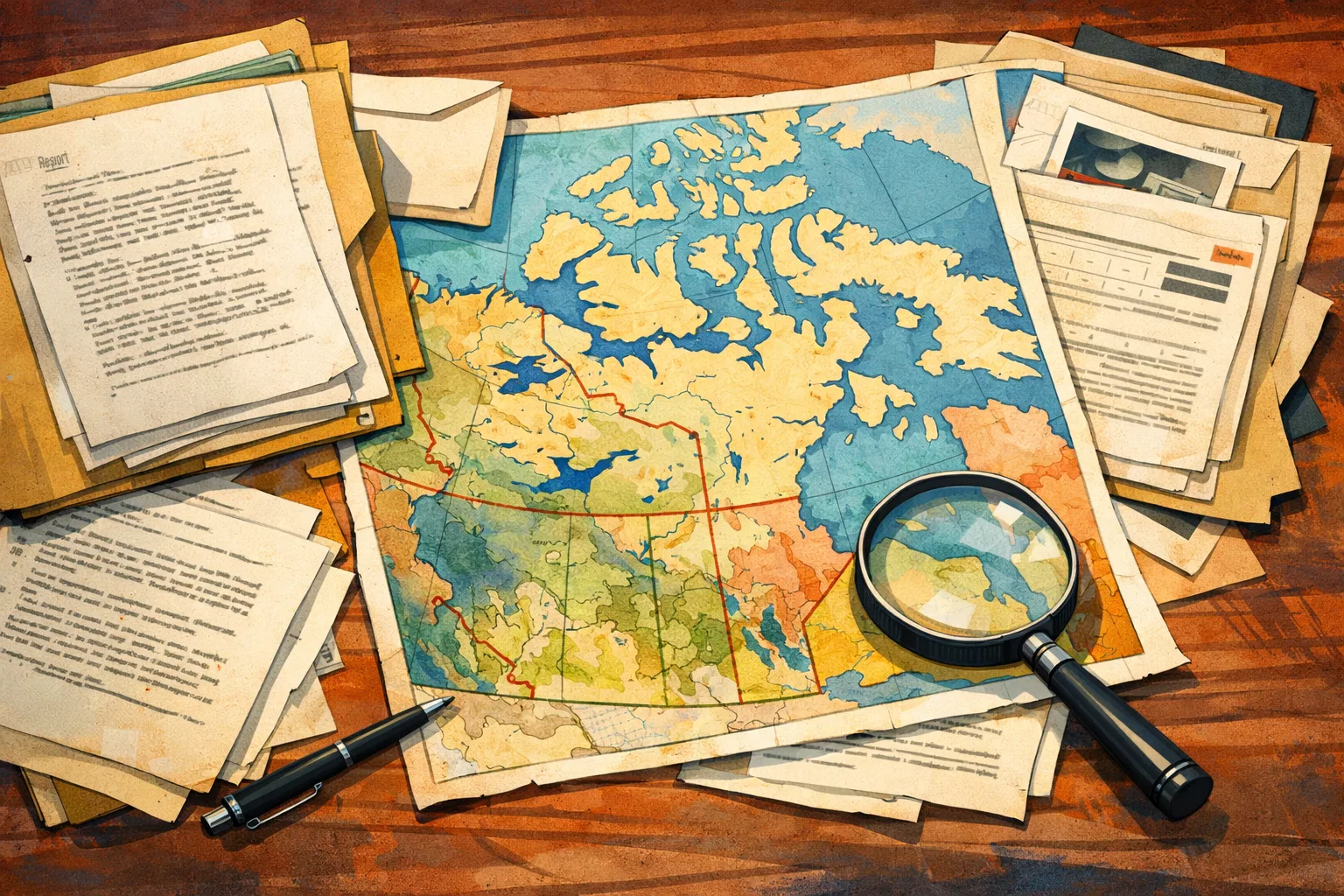
Northern UFO records in the Northwest Territories are patchy not because one dramatic archive is being hidden, but because Canadian reporting has never followed a single, stable path. A sighting near Yellowknife, Fort Simpson, Willow Lake, or a remote lake might have passed through the RCMP, Transport Canada, the Department of National Defence, the National Research Council, NAV CANADA, a local police detachment, an aviation safety database, a newspaper, or no formal system at all. Library and Archives Canada says its federal UFO collection came from four main bodies — National Defence, Transport, the National Research Council and the RCMP — and that even within its digitised files some records lack dates while about half lack a specific sighting location. [Canada]canada.cas UFOs: The search for the unknownCanada's UFOs: The search for the unknown - Canada.ca…
That matters for the Northwest Territories because many of its most interesting reports are exactly the kind most likely to suffer from thin documentation: remote sightings, aviation observations, sparse witness pools, delayed paperwork and records created for practical safety or policing purposes rather than for later historical research. The result is not a neat “X-Files” trail. It is a scattered Canadian paper trail in which a report can be real, officially logged, and still too incomplete to prove what was seen.
Which Agencies Recorded Canadian UFO Reports?
Canada’s UFO record was never housed in a single permanent UFO bureau. Library and Archives Canada’s public guide states that its government UFO collection was acquired from the Department of National Defence, Department of Transport, National Research Council and Royal Canadian Mounted Police. The documents cover 1947 to the early 1980s in the digitised collection and include correspondence, reports, memos, procedures, sighting files and generic reporting forms. [Canada]canada.cas UFOs: The search for the unknownCanada's UFOs: The search for the unknown - Canada.ca…
The Office of the Chief Science Advisor’s Sky Canada report gives the longer institutional picture. It describes a Canadian system in which responsibility moved between agencies, with long periods of low activity and limited follow-up. Project Magnet began in 1950 under Department of Transport engineer Wilbert Smith, while Project Second Storey was created in 1952 by the Defence Research Board to examine “flying saucer” reports over Canadian territory. Sky Canada notes that Second Storey developed a standardised form, but that it was never widely adopted. [Science.gc.ca]science.gc.caManagement of Public Reporting of Unidentified Aerial Phenomena in CanadaManagement of Public Reporting of Unidentified Aerial Phenomena in Canada
By 1967, responsibility for receiving UFO reports had shifted to the National Research Council. The NRC became the main federal destination for public UFO reports until 1995, when it stopped collecting them and transferred related material to what is now Library and Archives Canada. Sky Canada says most, though not all, NRC reports were compiled into the “Non-Meteoric Sightings” file, a term used for cases not attributed to meteors. [Science.gc.ca]science.gc.caManagement of Public Reporting of Unidentified Aerial Phenomena in CanadaManagement of Public Reporting of Unidentified Aerial Phenomena in Canada
For Northwest Territories readers, the important point is that “official file” can mean several different things. A report might be:
- an RCMP detachment report created because a member of the public came to police;
- a National Research Council file created because a case was forwarded for possible astronomical or meteor explanation;
- a Department of Transport or later Transport Canada aviation record;
- a National Defence or RCAF-related communication if the sighting touched air defence or vital intelligence reporting;
- a Library and Archives Canada record preserved after the original agency stopped handling UFO material.
That varied chain explains why two reports from the same region can look very different. A lake-impact claim might read like a police witness statement. A pilot sighting might appear as a brief aviation occurrence. A public sighting might survive only as a newspaper story, a later database entry, or not at all.

Why Dates and Locations Can Be Incomplete
The simplest reason northern UFO records are difficult to trace is that Canada’s own archive warns researchers not to treat place and date searches as complete. Library and Archives Canada says some documents are undated and that only about half refer to a specific UFO sighting location. It also cautions that searching by sighting date or location will return only partial results if that information appears on the original document. [Canada]canada.cas UFOs: The search for the unknownCanada's UFOs: The search for the unknown - Canada.ca…
That is a serious limitation for Northwest Territories cases. The territory’s historical records may use older place names, detachment names, mining-camp references, lake names, or regional descriptors rather than modern searchable geography. A sighting near Yellowknife may be filed under an RCMP administrative unit, an aviation facility, a witness’s address, a lake district, or a broader “N.W.T.” location. If the original paperwork did not put “Northwest Territories” in a searchable field, a modern reader may miss it.
The 1960 Clan Lake case shows both the value and the frustration of the file trail. A transcribed RCMP report states that a witness contacted the Yellowknife office after seeing a strange object strike the water at Clan Lake on 22 June 1960. The statement describes a noise “like a big plane in the distance”, a splash, an object with arms or spokes rotating in the water, cut and burnt grass, disturbed lake bottom, and a rough object width of four to six feet. [The Experiencer Support Association]experiencersupport.orgThe Experiencer Support Association RCMP UFO Report: Strange Object Striking Clan Lake, Northwest Territories – July 19 1960 (Report 1) |…
Yet even this stronger-than-usual case is not proof of an extraordinary craft. It is a record of what was reported and how police documented it. The surviving text contains redactions, later report dates, witness statements, local observations and physical descriptions, but it does not deliver a recovered object or a final identification. The archive strengthens the case as a serious historical report; it does not turn the claim into a confirmed explanation.
The same problem appears in less famous Northwest Territories references. Historical research into Canada’s UFO files has identified RCMP drawings and reports from places such as Fort Simpson and Willow Lake in the late 1960s, but those traces are often embedded within larger national files rather than presented as a clean territorial catalogue. Search results can therefore undercount northern material, especially when the original documents were created as routine paperwork rather than as a curated UFO database.
What the RCMP Trail Can and Cannot Prove
The RCMP matters in Northwest Territories UFO history because police detachments were often the most accessible public authority in remote communities. If a prospector, pilot, resident or traveller wanted to report a strange object, a Mountie might be the person who took the statement. That gives some northern reports an official character that pure folklore or later retelling does not have.
But an RCMP report is not the same as an RCMP endorsement of a UFO claim. Sky Canada says the RCMP generally does not investigate UAP sightings unless they relate to public safety or criminal investigation. It also says the RCMP currently has no formal policy for collecting or disseminating UAP reports, no UAP-specific classification system, and no specific guidance for call takers or members. A sighting can be categorised in a broad non-offence or public-safety bucket and become hard to retrieve as a UFO-related record later. [Science.gc.ca]science.gc.caManagement of Public Reporting of Unidentified Aerial Phenomena in CanadaManagement of Public Reporting of Unidentified Aerial Phenomena in Canada
That distinction is essential for reading Northwest Territories cases fairly. When a document says the RCMP took a report, it usually proves that a witness made a report and that police recorded it. It may also show whether officers considered a witness credible, whether they inspected a site, or whether they forwarded the file. It does not automatically prove that the object existed as described, that it was airborne technology, or that no ordinary explanation was possible.
Clan Lake is again a useful example. Its importance lies in the chain of reporting: a local witness statement, a named place, a date, physical-site claims and RCMP documentation. The doubts lie in what the file cannot supply: recovered material, independent instrumentation, a complete environmental reconstruction, or a definitive explanation. That is why the case remains interesting without becoming settled.
Aviation Reports Follow a Different Route
Modern northern UFO reports often surface through aviation systems rather than police archives. Transport Canada’s Civil Aviation Daily Occurrence Reporting System, known as CADORS, was launched in 1985 to provide timely information about civil aviation occurrences. Transport Canada says CADORS receives an average of 16,750 aviation incident and accident reports annually, and that NAV CANADA supplies about 80 per cent of the information used to create CADORS records. [Transport Canada]tc.canada.caTransport Canada The Civil Aviation Daily Occurrence Reporting System (CADORSTransport Canada The Civil Aviation Daily Occurrence Reporting System (CADORS
Sky Canada describes how pilot UAP reports usually move through this system. A pilot may report a sighting to the nearest air traffic control tower, flight service station or other air traffic unit. That unit files an Aviation Occurrence Report with NAV CANADA, which then goes to Transport Canada’s CADORS team for assessment and processing. UAP-related entries may be assigned to categories such as “Weather Balloon, Meteor, Rocket, UFO and Intelligence Sighting”, “Laser Interference”, or “Other Operational Incidences”. [Science.gc.ca]science.gc.caManagement of Public Reporting of Unidentified Aerial Phenomena in CanadaManagement of Public Reporting of Unidentified Aerial Phenomena in Canada
This route is built for aviation safety, not for solving mysteries for the public. CADORS helps identify hazards, track safety issues and support follow-up where needed. Transport Canada has also cautioned that CADORS information should be treated as preliminary, unsubstantiated and subject to change, and that the term “UFO” in CADORS can include drones, balloons, meteors, weather phenomena and birds rather than implying extraterrestrial origin. [Transport Canada]tc.canada.caTransport Canada4. High Altitude Object IncidentsTransport Canada4. High Altitude Object Incidents
The January 2023 Canadian North report near Yellowknife shows how this modern trail works. Cabin Radio reported that a Canadian North ATR 42-500 approaching Yellowknife saw two lights about 10 nautical miles northwest of the field at 11:15 pm on 29 January 2023. The crew’s radio exchange with Yellowknife air traffic control included the line that they were seeing “two lights dancing around”, while the controller said there was no reported traffic and nothing on radar. [Cabin Radio]cabinradio.caCabin Radio Canadian North crew reports ‘lights in sky’ over YellowknifeCabin Radio Canadian North crew reports ‘lights in sky’ over Yellowknife
The case is useful because it has several layers: a professional flight crew, an air traffic control exchange, a CADORS entry, no matching radar return reported by the tower, and later public reporting. It also shows why the file trail can remain unresolved. The event was logged, but the record did not identify the lights. Cabin Radio noted possible context including high-altitude balloon activity around the same period, while also pointing out that available timelines did not neatly place the known Chinese surveillance balloon near Yellowknife at the exact time of the sighting. [Cabin Radio]cabinradio.caCabin Radio Canadian North crew reports ‘lights in sky’ over YellowknifeCabin Radio Canadian North crew reports ‘lights in sky’ over Yellowknife
CIRVIS Adds Security Language Without Solving the Sighting
Some aviation-linked UFO reports are routed through CIRVIS, short for Communications Instructions for Reporting Vital Intelligence Sightings. DocumentCloud’s collection of Canadian CIRVIS materials describes procedural documents from the Royal Canadian Air Force, NAV CANADA and Transport Canada showing how UFO reports are typically handled in Canada, with sections for those organisations. [DocumentCloud]documentcloud.orgOpen source on documentcloud.org.
CIRVIS can sound dramatic because it belongs to a defence and airspace-warning culture. In practice, it does not mean a sighting has been judged extraordinary. It means a pilot or aviation authority is using a reporting path for objects that may be unidentified, suspicious, hostile, or otherwise relevant to airspace awareness.
That distinction matters in the North. The Northwest Territories sits within a larger northern aviation and air-defence environment: remote air routes, sparse radar and visual witnesses in some areas, military awareness of high-altitude objects, and cross-border NORAD responsibilities. A CIRVIS-related entry may show that a sighting was taken seriously as an aviation or security report. It does not, by itself, identify the object.
The Canadian North Yellowknife report demonstrates that point neatly. Cabin Radio reported that, according to CADORS, an Edmonton air traffic controller and shift manager were notified and a CIRVIS report was filed. The same article also states that the occurrence was tagged with categories including “weather balloon, meteor, rocket, Cirvus/UFO”. [Cabin Radio]cabinradio.caCabin Radio Canadian North crew reports ‘lights in sky’ over YellowknifeCabin Radio Canadian North crew reports ‘lights in sky’ over Yellowknife That combination is not a conclusion; it is a filing environment. It tells readers that the sighting entered an official safety-intelligence channel, while still leaving the object unexplained.

How Sky Canada Reframed the Reporting Problem
Sky Canada is important because it moved the public conversation away from “does Canada have secret UFO answers?” and towards a more useful question: can Canada collect, sort and explain reports consistently? The project, led by the Office of the Chief Science Advisor, was created to review current practices around public UAP reporting in Canada. It explicitly stated that it was not meant to prove or disprove extraterrestrial life, collect first-hand sighting data, or make the Chief Science Advisor the national reporting office. [Science.gc.ca]science.gc.caManagement of Public Reporting of Unidentified Aerial Phenomena in CanadaManagement of Public Reporting of Unidentified Aerial Phenomena in Canada
Its findings are directly relevant to the Northwest Territories. Sky Canada found that UAP reports in Canada are scattered across multiple government and non-government organisations. Its survey found that one in four respondents said they had personally witnessed a UAP, but only 10 per cent had reported their sighting and 40 per cent would not know whom to contact. It also found that federal departments may receive UAP information from the public or stakeholders, but few investigate unless the report fits a mandate such as national security, transport safety or public safety. [Science.gc.ca]science.gc.caManagement of Public Reporting of Unidentified Aerial Phenomena in CanadaManagement of Public Reporting of Unidentified Aerial Phenomena in Canada
That diagnosis explains why northern files feel uneven. A witness may not know whether to contact the RCMP, an airport, NAV CANADA, Transport Canada, a local astronomy club, a journalist, a UFO group, or no one. Even when a report is made, the receiving body may not compile it in a searchable UAP category. Sky Canada noted that most departments do not compile the UAP reports they receive, making it difficult to provide statistics or describe how witnesses were answered. [Science.gc.ca]science.gc.caManagement of Public Reporting of Unidentified Aerial Phenomena in CanadaManagement of Public Reporting of Unidentified Aerial Phenomena in Canada
The project’s recommendations also show what a better system would look like. Sky Canada proposed identifying a federal lead, establishing a dedicated service to collect testimonies and post analyses publicly, improving aviation reporting without stigma, encouraging agencies such as Transport Canada and the RCMP to forward data where appropriate, supporting open data, and developing public tools for data collection. [Science.gc.ca]science.gc.caManagement of Public Reporting of Unidentified Aerial Phenomena in CanadaManagement of Public Reporting of Unidentified Aerial Phenomena in Canada
For Northwest Territories UFO history, this reframing is more useful than sensational speculation. It says the main weakness in the record is not simply remoteness or secrecy. It is governance: fragmented intake, inconsistent categories, uneven follow-up, weak public guidance and records that were often designed for another purpose.
How to Read a Northern UFO File Without Overreading It
A Northwest Territories UFO record is strongest when it gives the reader several independent anchors: a date, a precise location, named or identifiable witnesses, original statements, aviation audio or logs, radar or sensor context, weather and astronomical conditions, follow-up actions, and a clear explanation of what was ruled in or out. Many records have only some of these pieces.
A practical reading of the file trail should separate three questions:
Was something reported?
An RCMP statement, CADORS entry or archived federal document can answer this quite well. Clan Lake and the Canadian North Yellowknife report both clear this threshold: they are not merely later folklore.
Was the report investigated?
Sometimes, but not always. Police might take a statement or inspect a location. Aviation authorities might log an occurrence and notify relevant units. Transport Canada says further follow-up may involve Transport Canada, NAV CANADA, the Transportation Safety Board or NORAD depending on the incident. [Transport Canada]tc.canada.caTransport Canada4. High Altitude Object IncidentsTransport Canada4. High Altitude Object Incidents
Was the object identified?
This is where many northern cases remain weak. A report can be official yet unresolved because no object was recovered, no instrument captured it, the observation was brief, or the record was filed for safety awareness rather than scientific analysis.
This approach protects two truths at once. It avoids dismissing witnesses simply because they reported something unusual, and it avoids treating every official record as proof of an extraordinary craft. The file trail is evidence of reporting, sometimes evidence of investigation, and only rarely evidence of identification.
What the Patchy Trail Means for the Northwest Territories
The Northwest Territories has a distinctive UFO history because its reports sit at the intersection of remote geography, aviation dependence, northern skies, sparse archives and federal responsibility. The territory’s records are not large enough to support sweeping claims about a hidden northern phenomenon. They are strong enough to show that unusual reports reached real Canadian institutions and sometimes generated serious paperwork.
The best way to understand those records is to follow the route of the report. Clan Lake belongs mainly to the RCMP and archival trail. The 2023 Yellowknife lights belong mainly to the aviation safety and CIRVIS trail. Older scattered reports may be buried in NRC, RCMP or Library and Archives Canada files under imperfect dates, older place names or broad administrative labels. Modern public sightings may never enter an official system unless they affect aviation safety, public safety or national security.
That is why “patchy” should not be read as “worthless”. A patchy archive can still tell us who reported what, which agency took notice, how Canadian institutions classified the event, and where the evidence ran out. For Northwest Territories UFO history, the most honest conclusion is also the most useful: the official files preserve fragments of real reporting, but the Canadian system has often made those fragments harder to find, compare and interpret than the sightings themselves.
Amazon book picks
Further Reading
Books and field guides related to Why Are Northern UFO Records So Patchy?. Use these as the next step if you want deeper reading beyond the article.
The UFO Experience
Provides historical perspective on collecting and evaluating reports.
eBay marketplace picks
Marketplace Samples
Example marketplace items related to this page. Use the search link to explore similar finds on eBay.



Endnotes
-
Source: canada.ca
Title: ‘s UFOs: The search for the unknown
Link: https://www.canada.ca/en/library-archives/collection/research-help/science-technology/ufos.htmlSource snippet
Canada's UFOs: The search for the unknown - Canada.ca...
-
Source: science.gc.ca
Title: Management of Public Reporting of Unidentified Aerial Phenomena in Canada
Link: https://science.gc.ca/site/science/en/office-chief-science-advisor/sky-canada-project/management-public-reporting-unidentified-aerial-phenomena-canada -
Source: tc.canada.ca
Title: Transport Canada The Civil Aviation Daily Occurrence Reporting System (CADORS)
Link: https://tc.canada.ca/en/aviation/publications/aviation-safety-letter/issue-2-2021/civil-aviation-daily-occurrence-reporting-system-cadors -
Source: tc.canada.ca
Title: Transport Canada4. High Altitude Object Incidents
Link: https://tc.canada.ca/en/binder/4-high-altitude-object-incidents -
Source: documentcloud.org
Link: https://www.documentcloud.org/documents/23845493-1-cirvis-procedures-combined/ -
Source: ised-isde.canada.ca
Title: sky canada project
Link: https://ised-isde.canada.ca/site/science/en/office-chief-science-advisor/sky-canada-projectSource snippet
Canada Project3 Dec 2025 — The January 2025 preliminary report for the Sky Canada Project can be found here. About the project. The Sky C...
Published: January 2025
-
Source: ised-isde.canada.ca
Link: https://ised-isde.canada.ca/site/science/sites/default/files/documents/Sky-Canada-Preview-January-2025.pdf -
Source: documentcloud.org
Link: https://www.documentcloud.org/documents/21273403-canadian-government-releases-20-years-of-ufo-reports/ -
Source: science.gc.ca
Title: sky canada report
Link: https://science.gc.ca/site/science/sites/default/files/documents/sky-canada-report.pdf -
Source: science.gc.ca
Title: questions and answers about sky canada project
Link: https://science.gc.ca/site/science/en/office-chief-science-advisor/sky-canada-project/questions-and-answers-about-sky-canada-project -
Source: archive.org
Title: Canada FOIA Part 06 Pages 1501 1800 djvu.txt
Link: https://archive.org/stream/CanadaUFO/Canada%20-%20FOIA%20Part%2006%20-%20Pages%201501-1800_djvu.txt -
Source: ia800806.us.archive.org
Title: CIA 613
Link: https://ia800806.us.archive.org/30/items/CIADocuments/CIA-613.pdf -
Source: rcmp.ca
Title: genealogy and archival research
Link: https://www.rcmp.ca/en/history-rcmp/genealogy-and-archival-research -
Source: experiencersupport.org
Link: https://www.experiencersupport.org/declassified/rcmp-ufo-report-strange-object-striking-clan-lake-northwest-territories-july-19-1960Source snippet
The Experiencer Support Association RCMP UFO Report: Strange Object Striking Clan Lake, Northwest Territories – July 19 1960 (Report 1) |...
-
Source: cabinradio.ca
Title: Cabin Radio Canadian North crew reports ‘lights in sky’ over Yellowknife
Link: https://cabinradio.ca/120760/news/yellowknife/canadian-north-crew-reports-lights-in-sky-over-yellowknife/ -
Source: facebook.com
Title: canada recorded 1052 ufo sightings in 2025 thats one every eight hoursin this ep
Link: https://www.facebook.com/TheCanadianGothic/posts/canada-recorded-1052-ufo-sightings-in-2025-thats-one-every-eight-hoursin-this-ep/1598993678897538/ -
Source: canadashistory.ca
Title: search for the unknown
Link: https://www.canadashistory.ca/explore/books/search-for-the-unknown -
Source: fokkernews.nl
Title: canadian north
Link: https://www.fokkernews.nl/articles/airlines/canadian-north -
Source: sites.google.com
Title: national research council
Link: https://sites.google.com/view/canadaufohistory/glossary/national-research-council -
Source: experiencersupport.org
Link: https://www.experiencersupport.org/declassified/rcmp-ufo-report-strange-object-striking-clan-lake-northwest-territories-august-25-1960 -
Source: activehistory.ca
Title: Canada, UFOs, and Wishful Thinking
Link: https://activehistory.ca/blog/2017/02/10/canada-ufos-and-wishful-thinking-2/ -
Source: documents.theblackvault.com
Title: Canada FOIA Part 29 Pages 8401 8759
Link: https://documents.theblackvault.com/documents/ufos/canada/Canada%20-%20FOIA%20Part%2029%20-%20Pages%208401-8759.pdf
Additional References
-
Source: youtube.com
Link: https://www.youtube.com/watch?v=BJInZy0daskSource snippet
Document reveals first known Canadian UFO study in nearly 30 years...
-
Source: youtube.com
Title: Document reveals first known Canadian UFO study in nearly 30 years
Link: https://www.youtube.com/watch?v=OGCggCRTh1cSource snippet
the Sky Canada Project Report Preview (with Chris Rutkowski)...
-
Source: nsa.gov
Link: https://www.nsa.gov/portals/75/documents/news-features/declassified-documents/ufo/janap_146.pdf -
Source: youtube.com
Title: the Sky Canada Project Report Preview (with Chris Rutkowski)
Link: https://www.youtube.com/watch?v=QGf_HpSxhM8Source snippet
The truth is out there: How Canada tracks UFOs...
-
Source: instagram.com
Link: https://www.instagram.com/reel/CoiCYAPgtrZ/ -
Source: aiaa.org
Link: https://aiaa.org/wp-content/uploads/2025/08/AIAA-UAPIOC-Opinion-Paper-UAP-Occupational-Safety-Reporting_ForPublication_kb.pdf -
Source: publicsafety.gc.ca
Link: https://www.publicsafety.gc.ca/lbrr/archives/cn000043947884-vol.2-eng.pdf -
Source: alpa.org
Link: https://www.alpa.org/supporting-pilots/pilot-groups/canadian-north -
Source: publications.gc.ca
Link: https://publications.gc.ca/site/eng/9.954480/publication.html -
Source: recherche-collection-search.bac-lac.gc.ca
Link: https://recherche-collection-search.bac-lac.gc.ca/eng/home/record?IdNumber=134925&app=FonAndCol
Topic Tree