Within PEI UFOs
Why PEI Skies Can Fool Witnesses
PEI's coastlines, aircraft routes and open horizons make some strange sightings easier to misread before they become UFO stories.
On this page
- Coastal horizons and distant lights
- Aircraft, meteors and high altitude objects
- A practical checklist for PEI reports
Page outline Jump by section
Introduction
Prince Edward Island’s UFO reports are often shaped by the same things that make the province visually striking: long coastal views, dark water, harbour lights, aircraft over open horizons, ferry or fishing traffic, and weather that can soften or distort distance. That does not mean every Island sighting is “just a light on the water”. It means PEI is a place where ordinary lights can look detached from their source, higher than they really are, or stranger than they would appear in a city street with buildings and trees for scale.
For PEI UFO history, this matters because several memorable Island reports involve lights seen across water or in sparse rural skies rather than close, detailed objects. The best first question is therefore not whether a witness was sincere, but whether the setting supplied enough clues to judge height, distance, motion and identity. Canadian agencies now use broad language for unidentified aerial phenomena, and official guidance recognises that drones, balloons, meteors, weather phenomena, satellites and ordinary aircraft can all enter the reporting stream. [Transport Canada]tc.canada.caTransport Canada4High Altitude Object Incidents - Transports Canada11 Aug 2023 — Transport Canada is aware of the recent sightings and events of Unidentif…
Why PEI’s coast can make ordinary lights look strange
PEI has more coastline than its small land area might suggest. Tourism and lighthouse sources commonly describe the Island as having more than 1,100 kilometres of coastline, with lighthouses, harbours and headlands marking the Gulf of St Lawrence and Northumberland Strait. [Welcome PEI]welcomepei.comWelcome PEIPEI LighthousesFebruary 12, 2014 — Prince Edward Island is home to 63 lighthouses spread along more than 1,100 kilometres of coastline. navigating the G… The Canadian Coast Guard’s Atlantic list of lights, buoys and fog signals explicitly covers the Coast of Prince Edward Island, Northumberland Strait and the Gulf and River St Lawrence, which is a reminder that the Island’s night landscape is not a blank horizon but a managed maritime environment full of navigational signals. [e-Navigation Portal]e-navigation.canada.cae-Navigation PortalList of Lights, Buoys and Fog Signals for the Atlantic Coast9 Sept 2015 — Contains lights in the Bay of Fundy the Coas…
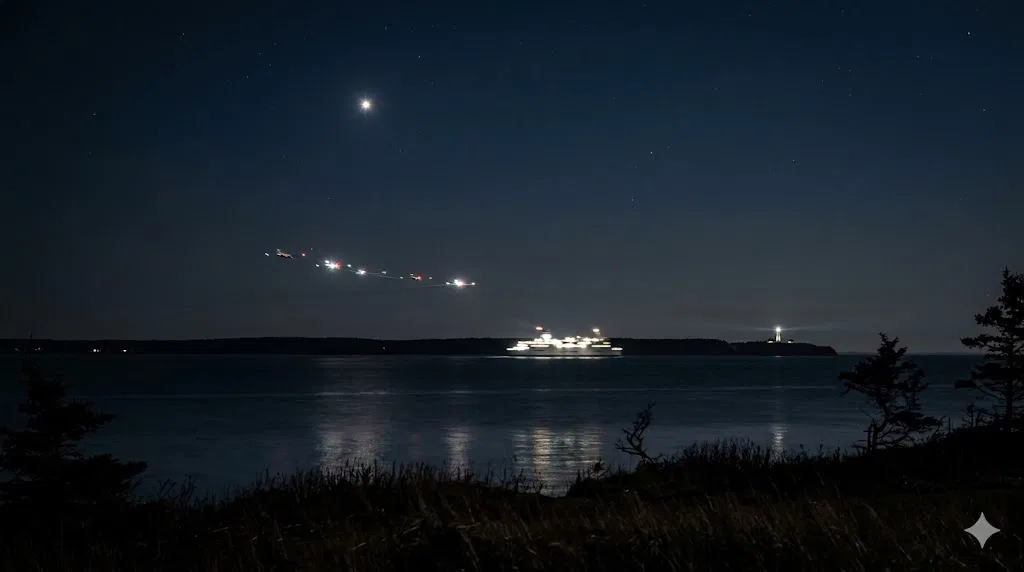
That matters for UFO interpretation because a coastal witness may see a light without seeing the boat, buoy, lighthouse structure or shoreline that explains it. Over dark water, the human eye has fewer reference points. A light that is actually low and distant can seem to hover; a flashing navigation aid can seem to pulse deliberately; a vessel moving towards or away from the observer can appear nearly stationary; and a light partly masked by haze, sea spray or low cloud can appear to blink, split or vanish.
Lighthouses are the most obvious example, but not the only one. The PEI Lighthouse Society lists several coastal lights with practical maritime histories, including Cape Bear, built to aid fishery and transportation on Northumberland Strait, and East Point, where the Gulf of St Lawrence and Northumberland Strait meet. [Prince Edward Island Lighthouse Society]peilighthousesociety.caPrince Edward Island Lighthouse Society HomeLawrence and Northumberland Strait meet to create a show of nature's force.Read more… East Point Lighthouse is also described in Canada’s Historic Places register as standing at the eastern tip of PEI, overlooking waters where the Atlantic, Northumberland Strait and Gulf of St Lawrence meet; the same record notes that navigation around that tip of the Island was difficult enough to make a lighthouse welcome in 1867. [Historic Places]historicplaces.caHistoric PlacesEast Point LighthouseLocated on the eastern tip of Prince Edward Island, the East Point Lighthouse overlooks the sea where…
The key point for UFO reports is not that a named lighthouse explains every sighting. It is that PEI’s shorelines contain many legitimate light sources, some fixed and some moving. A report that says “a bright light over the water” needs a bearing, an estimated elevation, a time, weather notes and a check against known aids to navigation before it can be treated as more than ambiguous.
When the horizon removes scale
Many Island sightings become puzzling because the witness is looking across a mostly featureless scene. A light above a field, road or harbour can be compared with trees, poles, buildings, hills or clouds. A light over the Gulf of St Lawrence or Northumberland Strait may have almost no visible scale marker at all.
This is where two common mistakes enter PEI reports. First, witnesses often estimate distance from brightness. That is unreliable. The Canadian Aids to Navigation System warns that atmospheric conditions can have a considerable effect on light transmission and that the distance to a light cannot be reliably estimated from apparent brightness. It also notes that colour discrimination can become difficult under some conditions. [Waves Vagues]waves-vagues.dfo-mpo.gc.caOpen source on gc.ca. A bright white light may therefore feel nearby and airborne even when it is farther away, lower, or partly altered by the air between the observer and the source.
Second, witnesses often read apparent movement as real movement. In a dark or featureless visual field, a single point of light can seem to drift or wobble even if it is stationary. UFO investigators and sceptical analysts often call this the autokinetic effect: when a small isolated light in darkness appears to move because the observer lacks stable visual references. [Skeptical Inquirer]skepticalinquirer.orgSkeptical Inquirer UFO Identification ProcessSkeptical Inquirer UFO Identification Process This is especially relevant for PEI shore observations because a person looking out over black water may be staring at one or two lights with little else in view.
Atmospheric refraction can complicate matters further. Mirages and related optical effects occur when light bends through air layers of different temperature and density; over water, distant objects near the horizon can be displaced, stretched, lifted or distorted. [HyperPhysics]hyperphysics.phy-astr.gsu.eduOpen source on gsu.edu. PEI’s spring and coastal weather can provide the kind of layered air that makes distant light interpretation harder. NAV CANADA’s Atlantic weather manual notes that fog is a major spring problem as Gulf ice breaks up and warmer air masses move into the Maritimes, with low stratus also developing in northerly winds off the Gulf. [NAV CANADA]navcanada.caNAV CANADAlawm-atlantic-en.pdfNAV CANADAlawm-atlantic-en.pdf
This does not prove that a specific PEI UFO report was a mirage. It does show why coastal reports should be handled cautiously when they depend on naked-eye impressions of height, distance and motion.
Aircraft are more confusing when seen head-on
Aircraft are an obvious candidate in many UFO reports, but PEI adds a particular twist: an approaching aircraft over a dark horizon may look like a hovering or slowly brightening object rather than a plane. If it is flying roughly towards the observer, its apparent sideways movement can be minimal. Landing lights can dominate the view before navigation lights become clear. If the aircraft later turns, descends or passes behind cloud, the same light can seem to change behaviour suddenly.
Charlottetown Airport is PEI’s scheduled commercial airport, and its own live flight information shows regular connections with cities such as Toronto, Montreal, Ottawa and Calgary. [YYG]flyyyg.comarrivals departuresarrivals departures Travel PEI’s meetings site describes Charlottetown Airport as the province’s only commercial airport, with non-stop and seasonal routes through major hubs. [Meet PEI]meetpei.comOpen source on meetpei.com. That means aircraft checks should be routine for modern PEI sightings, especially those near evening arrival and departure windows.
The trap is that “aircraft” does not always look like a familiar plane. At night, even pilots are trained to be wary of visual illusions. Transport Canada’s night-flying safety material highlights deteriorating weather and the “black-hole illusion” as major hazards, and emphasises the need to cross-check visual impressions. [Transport Canada]tc.canada.caTransport Canada Hazards Associated with Flying at NightTransport Canada Hazards Associated with Flying at Night For a ground witness on PEI, the same wider lesson applies: a dark foreground, dark sea and scattered lights can make the sky feel deeper, emptier and more mysterious than it is.
Aircraft explanations are strongest when the sighting time, direction and apparent movement line up with flight data. They are weaker when the report includes close-range detail, multiple independent viewing angles, radar correlation, physical effects or a path inconsistent with known traffic. Most coastal-light reports sit between those extremes: plausible aircraft candidates exist, but the original data are often too thin to close the case.
Meteors, satellites and high-altitude objects
Not every PEI misidentification risk is coastal. Some reports begin with a bright object crossing open sky, a sudden flash, or a silent light that appears and disappears. In those cases, the likely candidates widen to meteors, satellites, balloons, drones and other high-altitude objects.
Transport Canada’s high-altitude object briefing is useful because it avoids sensational language. It says Canadian authorities have dealt with sightings of unidentified flying objects in Canadian airspace, but it also frames such events as aviation-safety matters involving possible remotely piloted aircraft, balloons, meteors, weather phenomena and birds. [Transport Canada]tc.canada.caTransport Canada4High Altitude Object Incidents - Transports Canada11 Aug 2023 — Transport Canada is aware of the recent sightings and events of Unidentif… The Office of the Chief Science Advisor’s Sky Canada material similarly states that astronomical objects such as planets, stars and meteors can be misidentified, and that drones, balloons, satellites, sky lanterns and experimental aircraft can also be reported as UAPs when their lighting or movement seems unusual. [Science.gc.ca]science.gc.caclassified as UAPs by observers…
Meteors are a special source of confusion because they can be brief, bright and startling. A large fireball can seem much closer than it is, and witnesses in different places may describe the same object as travelling in different directions depending on their viewing angle. The practical distinction is duration. A meteor usually lasts seconds, not minutes. A light that remains in one area, brightens and dims repeatedly, or is filmed for a long period is less likely to be a simple meteor, though it may still be an aircraft, satellite, drone, lantern or marine light.
Satellites and spacecraft can also catch people out. They may appear as steady moving points, flare briefly when reflecting sunlight, or vanish when entering Earth’s shadow. They are especially likely to be noticed in rural or coastal PEI because darker skies make faint moving objects easier to see than they are in urban glare. The difference between a useful report and a weak one is often whether the witness recorded exact time, direction and elevation well enough to check against sky-tracking tools later.
The Kensington lesson: video does not automatically remove ambiguity
The 2014 Kensington case is the clearest PEI example of how coastal lights can become a durable UFO story. The reported sighting involved John Sheppard at Twin Shores campground near Kensington, looking out over the Gulf of St Lawrence late at night and filming unusual lights. Secondary accounts of the case describe MUFON treating it as a notable or “confirmed” case, while sceptical responses raised alternatives such as a drone, plane or lantern. [Audioboom]audioboom.com4670465 the 2014 kensington pei ufo sighting4670465 the 2014 kensington pei ufo sighting
The case is useful here not because it has been definitively solved, but because it shows the limits of a dark coastal video. A phone camera can prove that a light was present, preserve timing, and capture changes in brightness. It may not prove distance, size, height, identity or whether the source is over water, on the water, or much farther away than it appears. Vice’s critical coverage of the CBC-reported case noted that the footage showed small lights in a mostly black field of view, which is exactly the kind of visual setting where scale and motion are hardest to judge. [VICE]vice.comDid the CBC Just Confirm the Existence of Aliens?Did the CBC Just Confirm the Existence of Aliens?
That does not make the witness foolish, dishonest or unimportant. It means that a coastal PEI video should be treated as a starting point, not a conclusion. The strongest follow-up questions are practical: What compass direction was the camera facing? What was the tide, weather and visibility? Were there vessels offshore? Were aircraft approaching or departing? Were there drones, lanterns or local events nearby? Did anyone else record the same light from a different location? Without those checks, the video remains interesting but underdetermined.
A practical checklist for PEI reports
A good PEI UFO report does not need to be dramatic. It needs enough detail to separate an unknown from a familiar object seen under difficult conditions. For coastal lights and open-sky sightings, the most useful checklist is simple.
Record the exact time and place. The date, local time and viewing location make later checks possible. “Late evening near the shore” is much weaker than “11:35 p.m. from the north shore facing the Gulf”.
Note the direction and elevation. A compass bearing, even from a phone, is more useful than “over the water”. Elevation should be described modestly: near the horizon, halfway up the sky, overhead, or above a known landmark.
Separate brightness from distance. A bright light is not necessarily close. Canadian navigation guidance explicitly warns that apparent brightness is a poor guide to distance, especially under changing atmospheric conditions. [Waves Vagues]waves-vagues.dfo-mpo.gc.caOpen source on gc.ca.
Check marine lights first on coastal reports. PEI has fixed lighthouses, harbour lights, buoys and vessel traffic. The Canadian Coast Guard’s Atlantic aids-to-navigation publications exist precisely because coastal waters contain many formal light sources with defined characteristics. [e-Navigation Portal]e-navigation.canada.cae-Navigation PortalList of Lights, Buoys and Fog Signals for the Atlantic Coast9 Sept 2015 — Contains lights in the Bay of Fundy the Coas…
Check aircraft next. Charlottetown’s live arrivals and departures, public flight trackers and known routes to Toronto, Montreal, Ottawa and western Canadian cities can quickly explain some lights that seem to hover, brighten or move slowly. [YYG]flyyyg.comarrivals departuresarrivals departures
Treat short flashes differently from long sightings. A one- or two-second streak suggests a meteor or re-entry candidate more strongly than a light observed for ten minutes. A long-duration light needs checks against aircraft, satellites, drones, vessels and fixed aids.
Look for independent angles. One video from one shoreline is often ambiguous. Two observers several kilometres apart, facing known directions, can make triangulation possible and reduce the risk of mistaking a low distant light for a high nearby object.
What this means for PEI UFO history
PEI’s coastal-light problem does not erase the province’s UFO history. It explains why that history must be read carefully. Reports from places such as Summerside, Kensington, North Rustico or other shoreline communities sit in a landscape where aviation, marine navigation, weather and open horizons overlap. That overlap makes some sightings genuinely hard to identify after the fact, especially when the original report lacks photographs, radar data, exact bearings or independent witnesses.
The fairest conclusion is that PEI is a high-ambiguity environment rather than a high-certainty one. Its open skies make unusual lights easier to notice, while its coastlines make those same lights easier to misread. For readers, investigators and local historians, the strongest approach is neither automatic debunking nor automatic belief. It is disciplined sorting: preserve the report, respect the witness, check the coastal and aviation setting, and reserve “unresolved” for cases where ordinary explanations have been tested rather than merely overlooked.
Amazon book picks
Further Reading
Books and field guides related to Why PEI Skies Can Fool Witnesses. Use these as the next step if you want deeper reading beyond the article.
The UFO Experience
Focuses on evaluating UFO reports and distinguishing observations from explanations.
Identified Flying Objects
Provides context for how unusual aerial sightings are interpreted and debated.
NightWatch
Helps readers identify celestial objects often mistaken for unusual aerial phenomena.
Meteorology Today
Explains atmospheric effects that can distort lights, distance, and visibility.
eBay marketplace picks
Marketplace Samples
Example marketplace items related to this page. Use the search link to explore similar finds on eBay.



Endnotes
-
Source: tc.canada.ca
Title: Transport Canada4
Link: https://tc.canada.ca/en/binder/4-high-altitude-object-incidentsSource snippet
High Altitude Object Incidents - Transports Canada11 Aug 2023 — Transport Canada is aware of the recent sightings and events of Unidentif...
-
Source: science.gc.ca
Link: https://science.gc.ca/site/science/en/office-chief-science-advisor/sky-canada-project/management-public-reporting-unidentified-aerial-phenomena-canadaSource snippet
classified as UAPs by observers...
-
Source: e-navigation.canada.ca
Link: https://e-navigation.canada.ca/gn/description/eng/1449a2d2-ba89-4868-b606-931b7624c216Source snippet
e-Navigation PortalList of Lights, Buoys and Fog Signals for the Atlantic Coast9 Sept 2015 — Contains lights in the Bay of Fundy the Coas...
-
Source: e-navigation.canada.ca
Title: e-Navigation Portal CCG e-Nav
Link: https://e-navigation.canada.ca/gn/index-en?category-aidsToNavigation=aidsToNavigationSource snippet
e-Navigation PortalCCG e-Nav - Data CatalogList of Lights, Buoys and Fog Signals for Pacific Coast. Contains lights in British Columbia i...
-
Source: flyyyg.com
Title: arrivals departures
Link: https://flyyyg.com/passengers/flights/arrivals_departures/ -
Source: meetpei.com
Link: https://meetpei.com/member/charlottetown-airport/ -
Source: tc.canada.ca
Title: Transport Canada Hazards Associated with Flying at Night
Link: https://tc.canada.ca/en/aviation/publications/system-safety-summer-briefing-kit-tp-14112/hazards-associated-flying-night-powerpoint-presentation -
Source: audioboom.com
Title: 4670465 the 2014 kensington pei ufo sighting
Link: https://audioboom.com/posts/4670465-the-2014-kensington-pei-ufo-sighting -
Source: vice.com
Title: Did the CBC Just Confirm the Existence of Aliens?
Link: https://www.vice.com/en/article/does-the-cbc-think-that-aliens-exist/ -
Source: canada.ca
Link: https://www.canada.ca/en/canadian-coast-guard/corporate/videos/canadian-aids-navigation-system-typical-waterway.html -
Source: ised-isde.canada.ca
Title: preview sky canada report ocsa
Link: https://ised-isde.canada.ca/site/science/en/office-chief-science-advisor/sky-canada-project/preview-sky-canada-report-ocsa -
Source: science.gc.ca
Title: sky canada report
Link: https://science.gc.ca/site/science/sites/default/files/documents/sky-canada-report.pdf -
Source: welcomepei.com
Title: Welcome PEIPEI Lighthouses
Link: https://welcomepei.com/pei-lighthouses/Source snippet
February 12, 2014 — Prince Edward Island is home to 63 lighthouses spread along more than 1,100 kilometres of coastline. navigating the G...
Published: February 12, 2014
-
Source: peilighthousesociety.ca
Title: Prince Edward Island Lighthouse Society Home
Link: https://peilighthousesociety.ca/Source snippet
Lawrence and Northumberland Strait meet to create a show of nature's force.Read more...
-
Source: historicplaces.ca
Link: https://www.historicplaces.ca/en/rep-reg/place-lieu.aspx?id=19729Source snippet
Historic PlacesEast Point LighthouseLocated on the eastern tip of Prince Edward Island, the East Point Lighthouse overlooks the sea where...
-
Source: waves-vagues.dfo-mpo.gc.ca
Link: https://waves-vagues.dfo-mpo.gc.ca/library-bibliotheque/349667.pdf -
Source: skepticalinquirer.org
Title: Skeptical Inquirer UFO Identification Process
Link: https://skepticalinquirer.org/2018/11/ufo-identification-process/ -
Source: hyperphysics.phy-astr.gsu.edu
Link: https://hyperphysics.phy-astr.gsu.edu/hbase/atmos/mirage.html -
Source: navcanada.ca
Title: NAV CANADAlawm-atlantic-en.pdf
Link: https://www.navcanada.ca/en/lawm-atlantic-en.pdf -
Source: flyyyg.com
Link: https://flyyyg.com/ -
Source: navcanada.ca
Link: https://www.navcanada.ca/en/ecfs_07_en.pdf -
Source: navcanada.ca
Title: ecfs 02 en
Link: https://www.navcanada.ca/en/ecfs_02_en.pdf -
Source: navcanada.ca
Link: https://www.navcanada.ca/en/ecfs_05_en.pdf -
Source: navcanada.ca
Link: https://www.navcanada.ca/en/ecfs_04_en.pdf -
Source: facebook.com
Link: https://www.facebook.com/heritagePEI/photos/did-you-know-pei-is-home-to-one-of-the-top-10-ufo-sightings-in-canada-for-worldu/3239106256120369/ -
Source: Wikipedia
Title: Atmospheric refraction
Link: https://en.wikipedia.org/wiki/Atmospheric_refraction -
Source: Wikipedia
Title: Autokinetic effect
Link: https://en.wikipedia.org/wiki/Autokinetic_effect -
Source: youtube.com
Link: https://www.youtube.com/watch?v=y6Euxa6-ndk -
Source: waves-vagues.dfo-mpo.gc.ca
Link: https://waves-vagues.dfo-mpo.gc.ca/library-bibliotheque/4107547x.pdf -
Source: ebsco.com
Link: https://www.ebsco.com/research-starters/science/mirage
Additional References
-
Source: youtube.com
Title: Canada’s Famous Officially Investigated UFO Incident | Shag Harbour UFO Incident
Link: https://www.youtube.com/watch?v=AffaetLkx2USource snippet
Prince Edward Island UFO sighting UFO over Charlottetown, Prince Edward Island, Canada...
-
Source: youtube.com
Title: Why Are Many UFO Sightings Just Misidentification?
Link: https://www.youtube.com/watch?v=dSfAIKDGvvISource snippet
Canada's Famous Officially Investigated UFO Incident | Shag Harbour UFO Incident...
-
Source: faa.gov
Link: https://www.faa.gov/sites/faa.gov/files/Night_Ops_Ch13.pdf -
Source: youtube.com
Title: One of Canada’s Strangest Sightings (S5) | The Proof Is Out There
Link: https://www.youtube.com/watch?v=aTr84e04SbESource snippet
How Does Misidentification Explain UFO Sightings?...
-
Source: youtube.com
Title: UFO over Charlottetown, Prince Edward Island, Canada
Link: https://www.youtube.com/watch?v=HnEKhqtQdzsSource snippet
One of Canada’s Strangest Sightings (S5) | The Proof Is Out There...
-
Source: youtube.com
Title: How Does Misidentification Explain UFO Sightings?
Link: https://www.youtube.com/watch?v=Vio1ubWY9GgSource snippet
Why Are Many UFO Sightings Just Misidentification?...
-
Source: instagram.com
Link: https://www.instagram.com/p/DWR5CXbjD1t/?hl=en -
Source: publications.gc.ca
Link: https://publications.gc.ca/collections/collection_2024/mpo-dfo/Fs151-9-2024-03-eng.pdf -
Source: instagram.com
Link: https://www.instagram.com/reel/DN4Ak8Akr53/?hl=en -
Source: facebook.com
Link: https://www.facebook.com/groups/1048433019096187/posts/1843632399576241/
Topic Tree