Within Nova Scotia UFOs
Did the Underwater Story Change the Case?
The later Shelburne claims made Shag Harbour more dramatic, but they also blurred what is documented and what is retrospective.
On this page
- How the Shelburne claims entered the narrative
- Why later testimony is harder to weigh
- The problem of separating 1967 from other stories
Page outline Jump by section
Introduction
The Shelburne underwater claims are the most disputed extension of Nova Scotia’s Shag Harbour UFO story. The core 1967 case is fairly simple: witnesses saw lights descend near Shag Harbour, authorities searched for a possible crash, and divers found no wreckage. The Shelburne thread made the story far more dramatic by adding claims of an object moving underwater, a later meeting with another object, naval secrecy, and, in some retellings, a separate NATO-era underwater encounter near Shelburne. The problem is that these additions are not supported in the same way as the original 1967 emergency response. Library and Archives Canada describes Shag Harbour as Canada’s most famous UFO incident and notes RCMP and Canadian Forces involvement, but the later Shelburne narrative depends much more on retrospective interviews, books, documentaries and oral testimony than on a comparable public official file. [LAC Research]recherche-research.bac-lac.gc.caLAC Research1967 Shag Harbour UFO Sighting and Related Research…
That difference matters. The Shelburne claims did not simply add detail; they changed the shape of the case. In the original public record, Shag Harbour is an unresolved coastal sighting with a failed underwater search. In later versions, it can become an underwater pursuit, a secret recovery operation, or even a second case mistakenly folded into the 1967 story. A careful reading does not require dismissing every witness memory, but it does require separating what was documented close to the time from what was reconstructed decades later.

How the Shelburne claims entered the narrative
The first layer to keep separate is the documented Shag Harbour search itself. Local and official accounts agree on the broad outline: witnesses saw orange lights descend towards the sea on 4 October 1967; people first thought an aircraft had crashed; RCMP and local boats responded; yellowish foam was reported on the water; and military divers later searched without finding material evidence. The Municipality of Barrington’s public account says the HMCS Granby was ordered to the location and divers searched the ocean bottom for several days without positive results. [Barrington Municipality]barringtonmunicipality.comBarrington Municipality Shag Harbour UFO Incident | Visiting UsBarrington Municipality Shag Harbour UFO Incident | Visiting Us
The archival and historical accounts are similarly cautious. Matthew Hayes’s history of Canadian UFO investigation cites a Department of National Defence memo stating that two days of underwater searching under good conditions produced “nil results”, and a later DND response said the search failed to produce material evidence that would explain or identify the object. Hayes also notes that the Shag Harbour case attracted official attention because it seemed to offer possible physical evidence, not merely witness testimony. [digitalcollections.trentu.ca+2digitalcollections.trentu.ca]Documented 1967 underwater search:Open source on trentu.ca.
The Shelburne element appears in a different register. It is tied chiefly to later UFO researchers, especially Chris Styles, who helped revive the case after the early press attention had faded. The Barrington account explicitly says the story had new life breathed into it through Styles’s research from 1993 onwards, based on newspaper clippings and interviews with original witnesses. [Barrington Municipality]barringtonmunicipality.comBarrington Municipality Shag Harbour UFO Incident | Visiting UsBarrington Municipality Shag Harbour UFO Incident | Visiting Us From there, the story expanded from a local crash-and-search incident into a broader South Shore underwater narrative.
One version, associated with later Shag Harbour books and documentaries, proposed that the object seen near Shag Harbour did not simply sink and vanish but travelled underwater towards another location, often linked in popular retellings to Shelburne or a second offshore site. Hayes summarises this as Styles’s claim that there was evidence for a second crash site farther along the shore, investigated secretly by DND, and that the craft may have travelled underwater to that location; Hayes adds that nothing was recovered from that alleged second site either. [digitalcollections.trentu.ca]Documented 1967 underwater search:Open source on trentu.ca.
Another layer came through media retellings. Library and Archives Canada’s catalogue entry for the 2000 Ocean Entertainment documentary describes it as being about two unidentified flying objects seen disappearing into the ocean near Shag Harbour in October 1967, and says that one week later “they took off again”. That catalogue description shows how, by 2000, the public-facing version had already moved beyond the simple search-and-no-wreckage account into a more elaborate underwater continuation. [Collection Search]recherche-collection-search.bac-lac.gc.caOpen source on gc.ca.

Why later testimony is harder to weigh
The Shelburne material is difficult to evaluate because it is mostly retrospective. That does not automatically make it false. People do remember important events years later, and military personnel may be reluctant to discuss sensitive Cold War activity. But delayed testimony creates practical problems: memories can merge, dates can drift, locations can be simplified, and later books or documentaries can influence how witnesses and readers frame earlier experiences.
This is especially important because the 1967 Shag Harbour file is already thin. Hayes notes that, despite the case’s fame, the surviving available documentation amounts to about twenty-five pages from DND or National Research Council files, and that no RCMP files on the crash have survived in the archives he examined. In other words, even the best-documented part of the case is not supported by a large, complete file. The Shelburne extension has to be judged against that baseline, not treated as if it sits on an equally solid official record. [digitalcollections.trentu.ca]Documented 1967 underwater search:Open source on trentu.ca.
The strongest point in favour of the original Shag Harbour story is not that it proves a craft was present. It is that witnesses, police, search-and-rescue channels and military divers were involved close to the time, and that official correspondence treated the incident seriously enough to search for physical evidence. Global News, in its 50th-anniversary coverage, described the Shag Harbour paper trail as unusually strong for a Canadian UFO case, with RCMP reports and telexes between military officials referring to unidentified flying objects rather than simply brushing the reports aside. [Global News]globalnews.caOpen source on globalnews.ca.
The Shelburne claims do not have the same evidential texture. They are rich in alleged detail but weaker in public documentation. Popular retellings describe divers, secret orders, underwater objects and Cold War alarms, but the reader usually reaches those claims through later interviews, secondary media accounts or self-published UFO literature rather than through a clean chain of contemporary, publicly verifiable Canadian records. That makes the Shelburne thread interesting, but also riskier.
This difference is visible in how later reporting frames the case. Vice’s 50th-anniversary report included the recollection of a search participant who said the crews searched the ocean and divers found nothing visible beyond foam on the water. It also noted later claims about a nearby secret underwater monitoring base and alleged underwater anomalies, but those claims are presented as part of the case’s speculative afterlife rather than as recovered wreckage or a confirmed official finding. [VICE]vice.comIn Search of the Truth Behind Canada's Most Infamous UFO SightingIn Search of the Truth Behind Canada's Most Infamous UFO Sighting…
The problem of separating 1967 from other stories
The most important development in the Shelburne thread is that at least one later version appears to separate the dramatic Shelburne underwater story from the 1967 Shag Harbour event altogether. A 2025 Popular Mechanics account, based on Styles’s later claims and his book Sweep Clear 5: NATO’s UFO Encounter, says Styles eventually concluded that the Shelburne incident belonged to a NATO minesweeping exercise in 1960, not to the Shag Harbour event seven years later. In that version, the Shelburne story involved divers allegedly encountering underwater UFOs during a military exercise, but it could not be the same object witnessed at Shag Harbour in 1967 because the chronology no longer worked. [Popular Mechanics]popularmechanics.comPopular Mechanics Divers’ Silent Pact Fuels Decades of UFO SpeculationPopular Mechanics Divers’ Silent Pact Fuels Decades of UFO Speculation
That is a major credibility issue for the wider legend. If the most dramatic underwater elements were originally mixed into the Shag Harbour story but later placed in 1960, they cannot be used as straightforward evidence that the 1967 object travelled underwater from Shag Harbour to Shelburne. They become a separate claim: still geographically Nova Scotian, still connected to Cold War maritime activity, but not direct evidence for the 1967 case.
The 1960 Shelburne version is itself highly contentious. Popular Mechanics reports claims that the episode involved a NATO minesweeping exercise, divers, alleged objects on the seabed, secrecy orders and even a DEFCON 1 alert. But those are extraordinary claims and require stronger evidence than emotional retrospective testimony. The article itself notes that the later date correction broke the neat link between Shelburne and Shag Harbour, even while Styles continued to believe the witnesses’ sincerity. [Popular Mechanics]popularmechanics.comPopular Mechanics Divers’ Silent Pact Fuels Decades of UFO SpeculationPopular Mechanics Divers’ Silent Pact Fuels Decades of UFO Speculation
There is a real Cold War context around Shelburne that helps explain why such stories can sound plausible without proving the UFO claim. A Canadian naval history paper on maritime response and underwater surveillance notes that, in the 1950s, Canadian and American defence planning shifted a sound surveillance facility to Shelburne, Nova Scotia, with seabed arrays and shore-based equipment connected to submarine detection work. That context makes underwater military secrecy in the Shelburne area historically plausible. It does not, by itself, verify claims about submerged UFOs, alien occupants, or a hidden recovery operation. [forposterityssake.ca]forposterityssake.caExceptional Circumstances132-133, 153. This important study was… per war plans because the US wanted to avoid involving NATO in its response…Read more…
What the Shelburne claims add, and what they weaken
The Shelburne retellings add narrative force. They make Shag Harbour feel less like a brief coastal mystery and more like a hidden maritime operation: an object descends, survives underwater, moves along the South Shore, is monitored or met by another object, and becomes entangled with Canadian, American or NATO activity. For readers and local tourism, that is a compelling story. It also fits Nova Scotia’s geography: fishing communities, naval infrastructure, Cold War surveillance, and a coastline where lights and water can turn ordinary uncertainty into a lasting mystery.
But the same additions can weaken the case as evidence. The original incident is strongest when described narrowly: witnesses reported lights descending into the sea; authorities searched because a crash seemed possible; no aircraft was missing; no wreckage was found; the object remained unidentified. Once the story adds a second underwater location, secret naval knowledge, non-public diver testimony and a separate 1960 NATO incident, the evidential burden rises sharply.
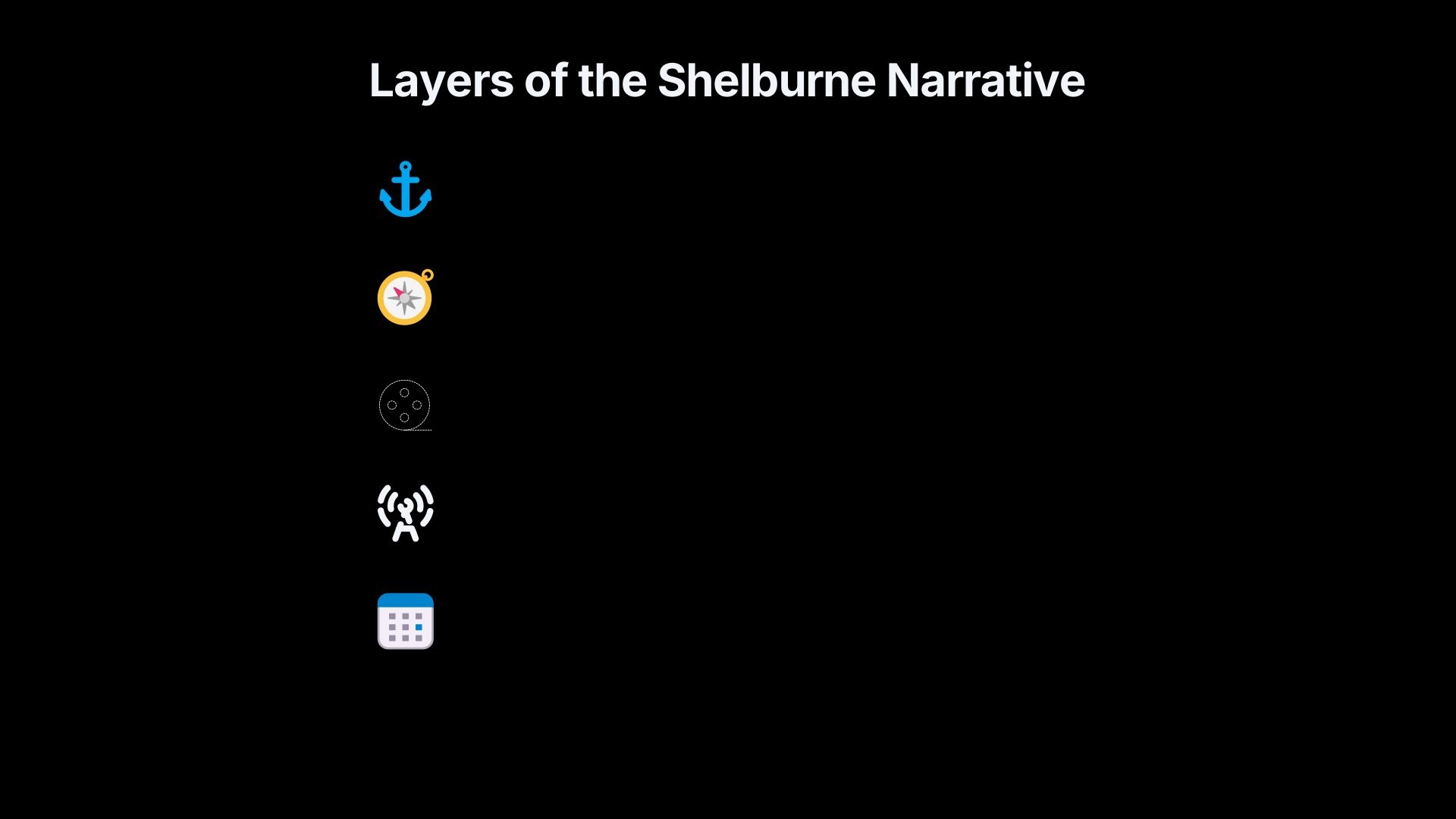
A useful way to judge the Shelburne thread is to divide it into three layers:
-
Documented 1967 underwater search: Military divers searched after the Shag Harbour incident and found no tangible evidence. This is the best-supported underwater element. digitalcollections.trentu.ca
-
Separate Shelburne 1960 claim: Later accounts place the more dramatic diver-and-NATO underwater story in 1960, which means it cannot serve as direct confirmation of the 1967 Shag Harbour object. Popular Mechanics
That separation does not solve Shag Harbour. The original case remains unexplained in the limited sense that the object was not identified and no conventional aircraft loss was found. But it does change the weight of the later story. The Shelburne thread is better understood as a contested case-family attached to Shag Harbour’s afterlife, not as a clean continuation of the documented 1967 event.
Did the underwater story change the case?
Yes, but not in a simple strengthening direction. The underwater story made Shag Harbour more famous, more cinematic and more attractive to UFO culture. It helped turn a Nova Scotia emergency-response mystery into a broader tale about hidden maritime evidence. It also helped Shag Harbour remain active in public memory through documentaries, books, anniversary events and local heritage interpretation. Library and Archives Canada’s inclusion of later books, documentary material and related research in its Shag Harbour list shows that the case is now preserved not only as an incident but as a continuing memory tradition. LAC Research
At the same time, the underwater retellings blurred categories that should remain separate. A witness report is not the same as a recovered object. A search is not proof of a crash. A Cold War naval setting is not proof of a UFO. A later diver story, even if sincerely told, is not equivalent to a contemporary log, photograph, sonar record or recovered material. The more elaborate the story becomes, the more important those distinctions become.
For Nova Scotia UFO history, Shelburne matters because it shows how a strong local case can accumulate additional claims over time. Shag Harbour’s core record is unusual by Canadian standards because official agencies responded to what might have been a crash. The Shelburne claims are unusual for a different reason: they show how retrospective testimony, military secrecy, Cold War geography and UFO publishing can reshape a case decades after the night in question.
The safest conclusion is therefore cautious. The Shelburne underwater claims did not conclusively explain Shag Harbour, and later reporting appears to have weakened the direct link by separating some of the most dramatic Shelburne material into a 1960 episode. What remains is a layered Nova Scotia story: a documented but unresolved 1967 search, a later underwater interpretation, and a disputed Shelburne narrative that is historically interesting but much harder to verify.
Amazon book picks
Further Reading
Books and field guides related to Did the Underwater Story Change the Case?. Use these as the next step if you want deeper reading beyond the article.
Dark Object
Directly covers the Nova Scotia Shag Harbour incident and later underwater claims.
UFOs
Supports the page’s official-records angle through government and witness-focused UFO reporting.
The Canadian UFO Report
Places Shag Harbour-style claims within the wider Canadian UFO reporting tradition.
The UFO Experience
Helps readers think about evidence quality, witness testimony, and classification of UFO cases.
eBay marketplace picks
Marketplace Samples
Example marketplace items related to this page. Use the search link to explore similar finds on eBay.
Endnotes
-
Source: vice.com
Title: In Search of the Truth Behind Canada’s Most Infamous UFO Sighting
Link: https://www.vice.com/en/article/in-search-of-the-truth-behind-canadas-most-infamous-ufo-sighting/Source snippet
In Search of the Truth Behind Canada's Most Infamous UFO Sighting...
-
Source: forposterityssake.ca
Title: Exceptional Circumstances
Link: https://www.forposterityssake.ca/RCN-DOCS/RCND0167.pdfSource snippet
132-133, 153. This important study was... per war plans because the US wanted to avoid involving NATO in its response...Read more...
-
Source: youtube.com
Title: The Shag Harbour UFO Incident
Link: https://www.youtube.com/watch?v=mPbDa5D7IUESource snippet
The Shag Harbour Incident - 2 - Discussion with Generation Why...
-
Source: youtube.com
Title: The Shag Harbour Incident
Link: https://www.youtube.com/watch?v=Qsl54IMp6BMSource snippet
3 - Exposing the Mystery...
-
Source: youtube.com
Title: The Shag Harbour Incident
Link: https://www.youtube.com/watch?v=MJB6dMQJiN0Source snippet
2022 UFO XPO - Chris Styles Presentation #2 - Sweep Clear 5...
-
Source: recherche-research.bac-lac.gc.ca
Link: https://recherche-research.bac-lac.gc.ca/eng/public/list/43130Source snippet
LAC Research1967 Shag Harbour UFO Sighting and Related Research...
-
Source: barringtonmunicipality.com
Title: Barrington Municipality Shag Harbour UFO Incident | Visiting Us
Link: https://www.barringtonmunicipality.com/Visiting-Us/shag-harbour-ufo-incident -
Source: recherche-collection-search.bac-lac.gc.ca
Link: https://recherche-collection-search.bac-lac.gc.ca/eng/home/record?app=filvidandsou&idnumber=418947&resource=folderlist -
Source: globalnews.ca
Link: https://globalnews.ca/news/3761270/canadas-best-documented-ufo-sighting-still-intrigues-50-years-on/ -
Source: youtube.com
Title: Shag Harbour, Nova Scotia
Link: https://www.youtube.com/watch?v=XNfLmFe_FWISource snippet
The Shag Harbour UFO Incident - 1 - The Event...
Topic Tree