Within Quebec UFOs
Where Do Quebec UFO Reports Go?
Quebec UFO reports sit within a larger Canadian record shaped by federal archives, aviation checks and fragmented responsibility.
On this page
- Federal UFO records and their limits
- Transport, defence and police roles
- How archival gaps affect old Quebec cases
Page outline Jump by section
Introduction
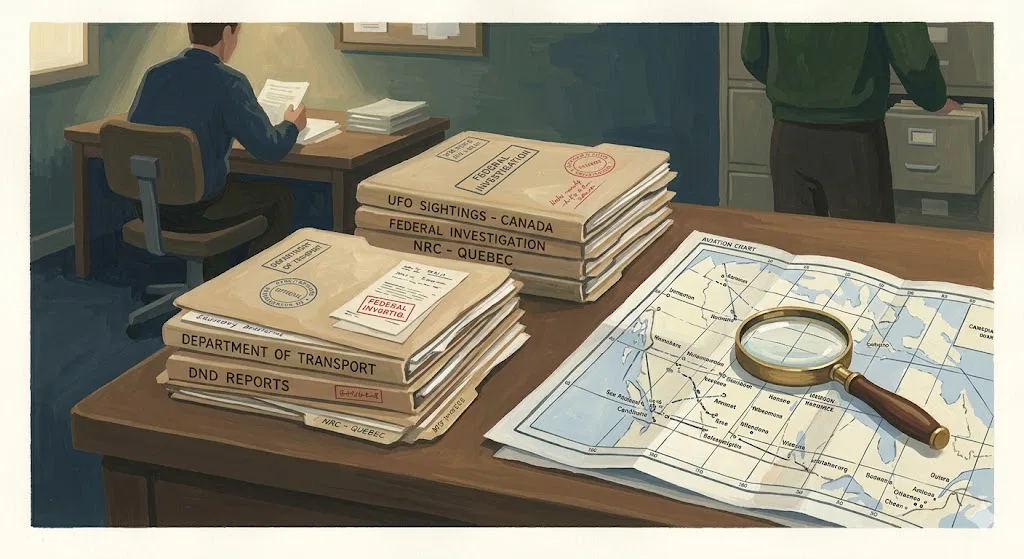
Quebec UFO reports have not usually gone into a single Quebec-only “UFO office”. They have passed through a patchwork of Canadian systems: old federal UFO files now held by Library and Archives Canada, aviation occurrence reports handled through Transport Canada and NAV CANADA, defence or NORAD-linked channels when airspace security is at issue, and police or local authorities when a sighting raises public-safety concerns. That fragmented route is the main reason Quebec cases can feel both well documented and frustratingly incomplete.
The key point is simple: official Canadian files can show that a sighting was reported, logged, circulated or checked against aviation and security information. They rarely prove what the witness saw. For Quebec, this distinction matters because the province’s best-known case, the 7 November 1990 sighting over Montreal’s Bonaventure Hotel, became famous partly because witnesses, police attention and aviation checks all entered the story, while later explanations remained contested. Canada’s current official review of unidentified aerial phenomena, the Sky Canada Project, treats that kind of uncertainty as a governance problem as much as a mystery problem. [Science.gc.ca]science.gc.caManagement of Public Reporting of Unidentified Aerial Phenomena in CanadaManagement of Public Reporting of Unidentified Aerial Phenomena in Canada
Federal files are not a single Quebec UFO archive
Library and Archives Canada describes its historical UFO collection as records acquired from four federal bodies: the Department of National Defence, the Department of Transport, the National Research Council and the Royal Canadian Mounted Police. The digitised material covers 1947 to the early 1980s and includes about 9,500 documents in forms such as correspondence, reports, memos and procedures. Some files concern particular sightings; others are administrative material about how to report or process unusual observations. [Canada]canada.cas UFOs: The search for the unknownCanada's UFOs: The search for the unknown - Canada.ca…
That matters for Quebec because a reader searching for “Quebec UFO files” may expect a neat provincial cabinet of cases. The real archive is messier. A Montreal sighting might appear under an aviation, defence, police or National Research Council route, or not be visible through a simple place-name search at all. Library and Archives Canada warns that only about half the documents mention a specific sighting location, that some are undated, and that searches by date or location produce only partial results if the original document happened to contain that information. [Canada]canada.cas UFOs: The search for the unknownCanada's UFOs: The search for the unknown - Canada.ca…
The archive also reflects the language and bureaucracy of its time. Library and Archives Canada notes that most files in the database were originally created in English and advises researchers to use English search terms for best results. For Quebec, where witnesses, newspapers and local investigators may use French place names or French descriptions, this creates an extra layer of friction: a case remembered locally in French may not be easy to retrieve through an English-language federal index. [Canada]canada.cas UFOs: The search for the unknownCanada's UFOs: The search for the unknown - Canada.ca…
The practical result is that official files are strongest when used as a trace of government handling, not as a complete catalogue of everything seen over Quebec. They can confirm that a report reached a federal desk, show what questions officials asked, and reveal whether an agency treated the matter as aviation, policing, defence, astronomy or public correspondence. They are much weaker as a final verdict on the object or light itself.
What the old Canadian system was actually trying to do
Canada’s official UFO handling changed repeatedly. The Sky Canada Project’s 2025 report summarises early federal involvement through Project Magnet, a Department of Transport-linked effort begun in 1950 by engineer Wilbert Smith, and Project Second Storey, a Defence Research Board committee created in 1952 to consider “flying saucer” reports passing over Canadian territory. Project Second Storey developed a standardised reporting form, but the form was never broadly adopted, and the committee concluded in the early 1950s that UFOs were not a security threat or a subject of scientific interest for the military. [Science.gc.ca]science.gc.caManagement of Public Reporting of Unidentified Aerial Phenomena in CanadaManagement of Public Reporting of Unidentified Aerial Phenomena in Canada
That early conclusion shaped later files. From 1954 to 1967, sightings still arrived at the RCMP, Transport Canada, National Defence, local police and other bodies, but the handling was intermittent. In 1967, responsibility for overseeing UFO reports shifted to the National Research Council, which became the main federal recipient for public reports. The NRC then collected information from members of the public, municipalities and federal agencies, often through astronomer Peter Millman, who might suggest explanations such as stars, planets, meteors or optical phenomena. [Science.gc.ca]science.gc.caManagement of Public Reporting of Unidentified Aerial Phenomena in CanadaManagement of Public Reporting of Unidentified Aerial Phenomena in Canada
For Quebec cases, this means the official trail was usually shaped by mandate. Defence cared most about threat or airspace implications. Transport-related channels cared about aviation safety. Police cared about public safety or possible criminal matters. The NRC was more likely to treat the observation as an interpretive or scientific-administrative problem. None of these routes was designed as a modern, province-by-province UFO investigation service.
A revealing Quebec example comes from Matthew Hayes’s historical research on Canada’s UFO investigations. Hayes notes an August 1965 incident at Foster, Quebec, in which an object fell to the ground and National Defence investigated quickly, then lost interest once it was judged man-made and marked in English. The reported official reasoning was that because the object was man-made, it was “no longer of direct interest”. [Digital Collections]digitalcollections.trentu.caA History of Canada s UFO Investigation 1950 1995The DND was quick to investigate but soon… the 1967 “reputed UFO landing marks” at Duhamel, Alberta remains a mystery.Read more… This is not a spectacular alien story; it is more useful than that. It shows how a Quebec incident could trigger official action when it looked like a physical object or possible security matter, then vanish from active concern once it no longer fit the agency’s mandate.
Transport, defence and police each see a different problem
Modern Quebec sightings can still enter official Canadian systems, but the route depends on what is at stake. Transport Canada’s Civil Aviation Daily Occurrence Reporting System, known as CADORS, was launched in 1985 to distribute timely information about civil aviation occurrences. Transport Canada says CADORS is used to capture information that air traffic service providers must report under Canadian aviation rules. [Transport Canada]tc.canada.caIt is also used to capture informationTransport CanadaThe Civil Aviation Daily Occurrence Reporting System…15 Jul 2021 — Launched in 1985, CADORS was created to provide tim…
In the UAP context, the Sky Canada Project says Transport Canada’s Civil Aviation Directorate collects reports on incidents, including UAP sightings, from pilots, air traffic controllers and the public; NAV CANADA units can file Aviation Occurrence Reports that are later sent to Transport Canada for CADORS assessment and processing. Public reports may also be filed through Transport Canada’s online aviation incident reporting route if they meet the criteria for inclusion. [Science.gc.ca]science.gc.caManagement of Public Reporting of Unidentified Aerial Phenomena in CanadaManagement of Public Reporting of Unidentified Aerial Phenomena in Canada
This is important for Quebec because many credible-looking modern reports are not “UFO investigations” in the popular sense. They may be aviation safety records. A pilot seeing an unidentified light near a route between Montreal and Quebec City, or an air traffic unit receiving a report near Quebec airspace, may generate a record because the object could affect flight safety. Transport Canada has also warned that the term “UFO” in CADORS can describe many things, including drones, balloons, meteors, weather phenomena and birds, and should not be read as meaning extraterrestrial origin. [Transport Canada]tc.canada.caTransport Canada4High Altitude Object Incidents - Transports Canada11 Aug 2023 — In the Civil Aviation Daily Occurrence Reporting System (CADORS), the ter…
Defence and airspace security are narrower. The Sky Canada Project reports that Defence Research and Development Canada has no formal UAP programme and no capacity or mandate to collect, receive or analyse citizens’ UAP reports. It also says the Royal Canadian Air Force does not typically investigate unexplained sightings except in the context of potential threats or distress. [Science.gc.ca]science.gc.caManagement of Public Reporting of Unidentified Aerial Phenomena in CanadaManagement of Public Reporting of Unidentified Aerial Phenomena in Canada For Quebec, that means “the military did not explain it” is not the same as “the military confirmed something extraordinary”. Often, it simply means the report did not meet a defence threshold.
Police are similarly mandate-bound. The Sky Canada Project says the RCMP has no formal policy for collecting or disseminating UAP reports and no UAP-specific classification system. Such reports can be categorised under broader non-criminal or aviation-related headings, or even lost within unrelated call categories. The same report lists the Sûreté du Québec among consulted organisations and notes that local and provincial police services generally approach such calls from a public-safety perspective rather than as specialist UAP investigators. [Science.gc.ca]science.gc.caManagement of Public Reporting of Unidentified Aerial Phenomena in CanadaManagement of Public Reporting of Unidentified Aerial Phenomena in Canada
The Bonaventure case shows both the value and the limits of official traces
The 7 November 1990 Montreal sighting over the Bonaventure Hotel is the Quebec case most readers expect official files to clarify. The Sky Canada Project lists it among five well-known Canadian UAP cases, describing a large oval luminous phenomenon seen in the evening over the hotel’s rooftop pool by about forty witnesses, including journalists and police officers. It also states that air traffic controllers confirmed there was no radar activity in the area. [Science.gc.ca]science.gc.caManagement of Public Reporting of Unidentified Aerial Phenomena in CanadaManagement of Public Reporting of Unidentified Aerial Phenomena in Canada
That official summary is useful, but it should not be overread. It supports several grounded points: the case was not simply a lone anonymous claim; police and media-linked witnesses were part of the public record; and aviation checks became part of the story. It does not prove a craft was present. A negative radar check can narrow some possibilities, but it can also be consistent with lights, reflections, atmospheric effects, misperceived distance, or something outside the relevant radar parameters.
This is where official records and sceptical analysis meet. For an urban Quebec case, the strongest files are often not dramatic disclosure documents but ordinary checks: Were aircraft in the area? Did controllers see anything? Did police attend? Did officials assign the matter to aviation safety, public order, or no further action? Those questions can strengthen the historical reliability of a report while still leaving the underlying phenomenon unresolved.
The Bonaventure case also illustrates a common archival trap. A famous sighting after the early 1980s sits partly outside Library and Archives Canada’s main digitised historical UFO database, which is strongest for earlier federal files. Later cases may be distributed across media accounts, local police memory, aviation records, access-to-information releases, private investigators and retrospective government summaries rather than one tidy federal dossier. That does not make the case worthless; it makes the evidence trail more fragmented.
Why old Quebec cases are hard to verify
Archival gaps are not incidental. They are built into the way Canada handled reports. Library and Archives Canada explicitly warns that its UFO database is uneven: some documents lack dates, around half lack a specific location, and location searches work only when the original file recorded a place in a searchable way. [Canada]canada.cas UFOs: The search for the unknownCanada's UFOs: The search for the unknown - Canada.ca… The Sky Canada Project reaches a similar conclusion for the present day, describing Canada’s UAP pathways as diverse and lacking a cohesive, standardised system for reporting and follow-up. [Science.gc.ca]science.gc.caManagement of Public Reporting of Unidentified Aerial Phenomena in CanadaManagement of Public Reporting of Unidentified Aerial Phenomena in Canada
For Quebec, three gaps are especially important.
First, jurisdiction fragments the evidence. A single sighting might involve municipal police, the Sûreté du Québec, Transport Canada, NAV CANADA, the RCMP, National Defence or no official agency at all. Each body stores records for its own purpose, not for UFO historians.
Second, the vocabulary changes. Older files may say “flying saucer”, “unknown object”, “non-meteoric sighting”, “light”, “incident”, “CIRVIS” or “aviation occurrence”. Searching only for “UFO Quebec” misses records filed under different terms.
Third, an official record is not the same as an official investigation. Many reports are logs, referrals or correspondence. They show that someone reported something and that an agency decided whether it mattered to its mandate. They do not necessarily show that photographs were analysed, witnesses were reinterviewed, astronomical checks were performed, or a final explanation was reached.
These limits do not weaken every Quebec case equally. A report with multiple independent witnesses, exact time and location, weather data, aviation checks, police attendance and preserved original statements is much stronger than a vague recollection decades later. But even strong administrative records usually stop short of proving an extraordinary cause.

What changed with Sky Canada
The Sky Canada Project is not a Quebec investigation and does not reopen old sightings. Its importance for Quebec is that it confirms the broader governance problem behind Quebec’s scattered UFO record. The project says Canadian UAP reports can be made through multiple channels, including Transport Canada, RCAF or DND operational networks, police services such as the RCMP and Sûreté du Québec, civil society organisations and astronomy groups. It identifies the lack of a cohesive, standardised reporting and follow-up system as a central weakness. [Science.gc.ca]science.gc.caManagement of Public Reporting of Unidentified Aerial Phenomena in CanadaManagement of Public Reporting of Unidentified Aerial Phenomena in Canada
The project’s recommendations point directly at the gaps that affect Quebec readers. It proposes identifying a federal lead for public UAP data, establishing a dedicated service to collect testimony, investigate cases and publish analyses, improving civil aviation reporting through Transport Canada and NAV CANADA, making UAP data openly available, supporting citizen science, and developing bilingual digital tools for standardised reporting. [Science.gc.ca]science.gc.caManagement of Public Reporting of Unidentified Aerial Phenomena in CanadaManagement of Public Reporting of Unidentified Aerial Phenomena in Canada
The bilingual point matters in Quebec. A reporting system that works only in practice for English-language users would reproduce one of the historical weaknesses of the archive. A useful Canadian system would need to preserve French-language witness testimony accurately while still allowing national comparison across provinces and territories.
Sky Canada also reframes official files away from spectacle. Its recommendations focus on transparency, data quality, public trust, aviation safety, scientific rigour and misinformation. That is a good fit for Quebec’s record, where the central public question is not simply “were aliens here?” but “what did Canadian institutions record, what did they check, what did they miss, and why is the answer still unclear?”

How to read an official Quebec UFO file without being misled
The safest way to read official Canadian files behind Quebec sightings is to treat them as administrative evidence. They can answer some questions very well: who received the report, when it was logged, which agency handled it, whether aviation or defence checks were made, and whether officials suggested a conventional explanation. They are much less reliable for answering the largest question on their own: what exactly was in the sky?
A useful reading test is to separate four levels of certainty:
Recorded: a witness report, memo, police note or aviation occurrence exists.
Checked: an agency made a specific comparison, such as aircraft, radar, weather, astronomy, drone activity or security relevance.
Explained: the file gives a plausible cause supported by the available facts.
Unresolved: the file lacks enough evidence for a firm answer, or the checks failed to identify a cause.
Many Quebec reports sit between “recorded” and “checked”. Fewer reach “explained” or “unresolved” in a strong evidential sense. That is why the absence of a neat answer should not be inflated into proof of a cover-up, but it should also not be dismissed as meaningless. The files show how Canadian institutions saw the problem: usually as aviation safety, public safety, scientific correspondence or defence triage, not as a standing investigation into extraordinary craft.
For Quebec UFO history, that is the real significance of the official record. It does not provide a hidden master key to every sighting. It provides a map of responsibility, hesitation and lost continuity: a national system in which reports moved from agency to agency, some were preserved, many were only lightly handled, and the most famous cases survived because witnesses, media attention and partial official checks kept them from disappearing.
Amazon book picks
Further Reading
Books and field guides related to Where Do Quebec UFO Reports Go?. Use these as the next step if you want deeper reading beyond the article.
UFOs
Focuses on official reports, government handling, aviation evidence, and institutional responses to unexplained sightings.
The UFO Experience
Examines sighting reports, classification systems, and the challenges of evaluating official case records.
American Cosmic
Explores how modern institutions, records, and narratives shape public understanding of UFO phenomena.
The Report on Unidentified Flying Objects
Provides insight into how military and official investigations handled unexplained aerial reports.
eBay marketplace picks
Marketplace Samples
Example marketplace items related to this page. Use the search link to explore similar finds on eBay.


Endnotes
-
Source: science.gc.ca
Title: Management of Public Reporting of Unidentified Aerial Phenomena in Canada
Link: https://science.gc.ca/site/science/en/office-chief-science-advisor/sky-canada-project/management-public-reporting-unidentified-aerial-phenomena-canada -
Source: canada.ca
Title: ‘s UFOs: The search for the unknown
Link: https://www.canada.ca/en/library-archives/collection/research-help/science-technology/ufos.htmlSource snippet
Canada's UFOs: The search for the unknown - Canada.ca...
-
Source: tc.canada.ca
Title: It is also used to capture information
Link: https://tc.canada.ca/en/aviation/publications/aviation-safety-letter/issue-2-2021/civil-aviation-daily-occurrence-reporting-system-cadorsSource snippet
Transport CanadaThe Civil Aviation Daily Occurrence Reporting System...15 Jul 2021 — Launched in 1985, CADORS was created to provide tim...
-
Source: tc.canada.ca
Title: civil aviation daily occurrence reporting system cadors manual tp 4044
Link: https://tc.canada.ca/en/aviation/aviation-publications/civil-aviation-daily-occurrence-reporting-system-cadors-manual-tp-4044Source snippet
Transport CanadaCivil Aviation Daily Occurrence Reporting System (CADORS...5 Sept 2025 — The purpose of the CADORS Manual is to outline...
-
Source: tc.canada.ca
Title: Transport Canada4
Link: https://tc.canada.ca/en/binder/4-high-altitude-object-incidentsSource snippet
High Altitude Object Incidents - Transports Canada11 Aug 2023 — In the Civil Aviation Daily Occurrence Reporting System (CADORS), the ter...
-
Source: ised-isde.canada.ca
Title: sky canada project
Link: https://ised-isde.canada.ca/site/science/en/office-chief-science-advisor/sky-canada-project -
Source: search.open.canada.ca
Link: https://search.open.canada.ca/qpnotes/record/tc%2CTC-2022-QP-00005 -
Source: canada.ca
Title: episode 053
Link: https://www.canada.ca/en/library-archives/collection/engage-learn/podcasts/discover/episode-053.html -
Source: ised-isde.canada.ca
Link: https://ised-isde.canada.ca/site/science/sites/default/files/documents/Sky-Canada-Preview-January-2025.pdf -
Source: tc.canada.ca
Title: ca Report a drone incident
Link: https://tc.canada.ca/en/aviation/drone-safety/report-drone-incident -
Source: science.gc.ca
Title: sky canada report
Link: https://science.gc.ca/site/science/sites/default/files/documents/sky-canada-report.pdf -
Source: science.gc.ca
Title: questions and answers about sky canada project
Link: https://science.gc.ca/site/science/en/office-chief-science-advisor/sky-canada-project/questions-and-answers-about-sky-canada-project -
Source: archive.org
Title: Canada FOIA Part 06 Pages 1501 1800 djvu.txt
Link: https://archive.org/stream/CanadaUFO/Canada%20-%20FOIA%20Part%2006%20-%20Pages%201501-1800_djvu.txt -
Source: digitalcollections.trentu.ca
Title: A History of Canada s UFO Investigation 1950 1995
Link: https://digitalcollections.trentu.ca/_flysystem/fedora/2022-04/A_History_of_Canada_s_UFO_Investigation_1950_1995.pdfSource snippet
The DND was quick to investigate but soon... the 1967 “reputed UFO landing marks” at Duhamel, Alberta remains a mystery.Read more...
-
Source: collectionscanada.gc.ca
Link: https://www.collectionscanada.gc.ca/databases/ufo/001057-110.01-e.php?PHPSESSID=p3nkrgrtp6rqto4smk2s3jodb7&brws_s=&q7=Royal+Canadian+Mounted+Police&sk=1211 -
Source: collectionscanada.gc.ca
Link: https://www.collectionscanada.gc.ca/databases/ufo/001057-110.01-e.php?PHPSESSID=ikeuf883c49qhgl7s83i5ioe45&brws_s=&q7=Department+of+National+Defence&sk=821 -
Source: facebook.com
Link: https://www.facebook.com/groups/350991197872690/posts/973435668961570/ -
Source: facebook.com
Link: https://www.facebook.com/PQBNews/posts/canadas-preeminent-ufologist-has-seen-an-uptick-in-reported-sightings-of-unident/5934906356591016/ -
Source: revenantjournal.com
Link: https://www.revenantjournal.com/contents/search-for-the-unknown-canadas-ufo-files-and-the-rise-of-conspiracy-theory-by-matthew-hayes-montreal-quebec-mcgill-queens-university-press-2022-isbn-978-0228010746-210pp-34/ -
Source: uaparchive.com
Link: https://uaparchive.com/maps/canada-map.html -
Source: canadashistory.ca
Title: search for the unknown
Link: https://www.canadashistory.ca/explore/books/search-for-the-unknown
Additional References
-
Source: youtube.com
Link: https://www.youtube.com/watch?v=IyhHQ0d6RJkSource snippet
The Proof Is Out There: Bizarre UFOs Hover Over Montreal The Proof Is Out There: Bizarre UFOs Hover Over Montreal (Season 3) | History HI...
-
Source: researchgate.net
Link: https://www.researchgate.net/publication/390980555_The_UAP_Assessment_Matrix_A_proposed_framework_for_evaluating_evidence_and_understanding_regarding_Unidentified_Anomalous_Phenomena -
Source: facebook.com
Link: https://www.facebook.com/BCFerries/posts/-bcfheadsup-breaking-crew-on-board-the-northern-expedition-were-notified-that-ca/6585130011519598/ -
Source: crkn-rcdr.ca
Link: https://www.crkn-rcdr.ca/sites/crkn/files/2020-09/CRKN_CanadianaCollectionsHeritage_2020-09-21.txt -
Source: documentcloud.org
Link: https://www.documentcloud.org/documents/21273403-canadian-government-releases-20-years-of-ufo-reports/ -
Source: scribd.com
Link: https://www.scribd.com/document/668905171/Canadian-Government-Releases-20-Years-of-Ufo-Reports -
Source: skybrary.aero
Link: https://skybrary.aero/articles/civil-aviation-daily-occurrence-reporting-system-cadors -
Source: facebook.com
Link: https://www.facebook.com/truecanadalovers/posts/more-than-1000-ufo-sightings-were-reported-across-canada-in-2025-according-to-th/1497323999069198/ -
Source: publications.gc.ca
Link: https://publications.gc.ca/site/eng/9.954480/publication.html -
Source: publications.gc.ca
Link: https://publications.gc.ca/collections/collection_2025/isde-ised/Iu4-443-2024-1-eng.pdf
Topic Tree