Within Coastal Skies
Why the sea horizon tricks the eye
Low stars, bright planets, meteors and refraction over water can make ordinary sky lights seem to move, pulse or lift above the sea.
On this page
- Twinkling stars and planets near the waterline
- Meteors versus prolonged sightings
- Mirage and refraction effects over coastal water
Page outline Jump by section
Introduction
Many unusual lights reported along Nova Scotia’s coast do not begin with aircraft or ships. They begin with the horizon itself. Over the Atlantic, bright stars, planets, meteors and distant lights can be altered by layers of air above the water, making familiar objects appear to hover, pulse, change colour, drift sideways or even rise from the sea. These effects are especially important when evaluating coastal UFO reports because witnesses are often looking across long stretches of dark water with few visual references.
 Recognising these mechanisms does not dismiss eyewitnesses. On the contrary, it explains why sincere observers can describe genuinely strange sights. In Nova Scotia’s UFO history, where many reports involve lights over the ocean or near the horizon, understanding atmospheric optics is often the difference between an unexplained mystery and a plausible natural interpretation.
Why the sea horizon tricks the eye
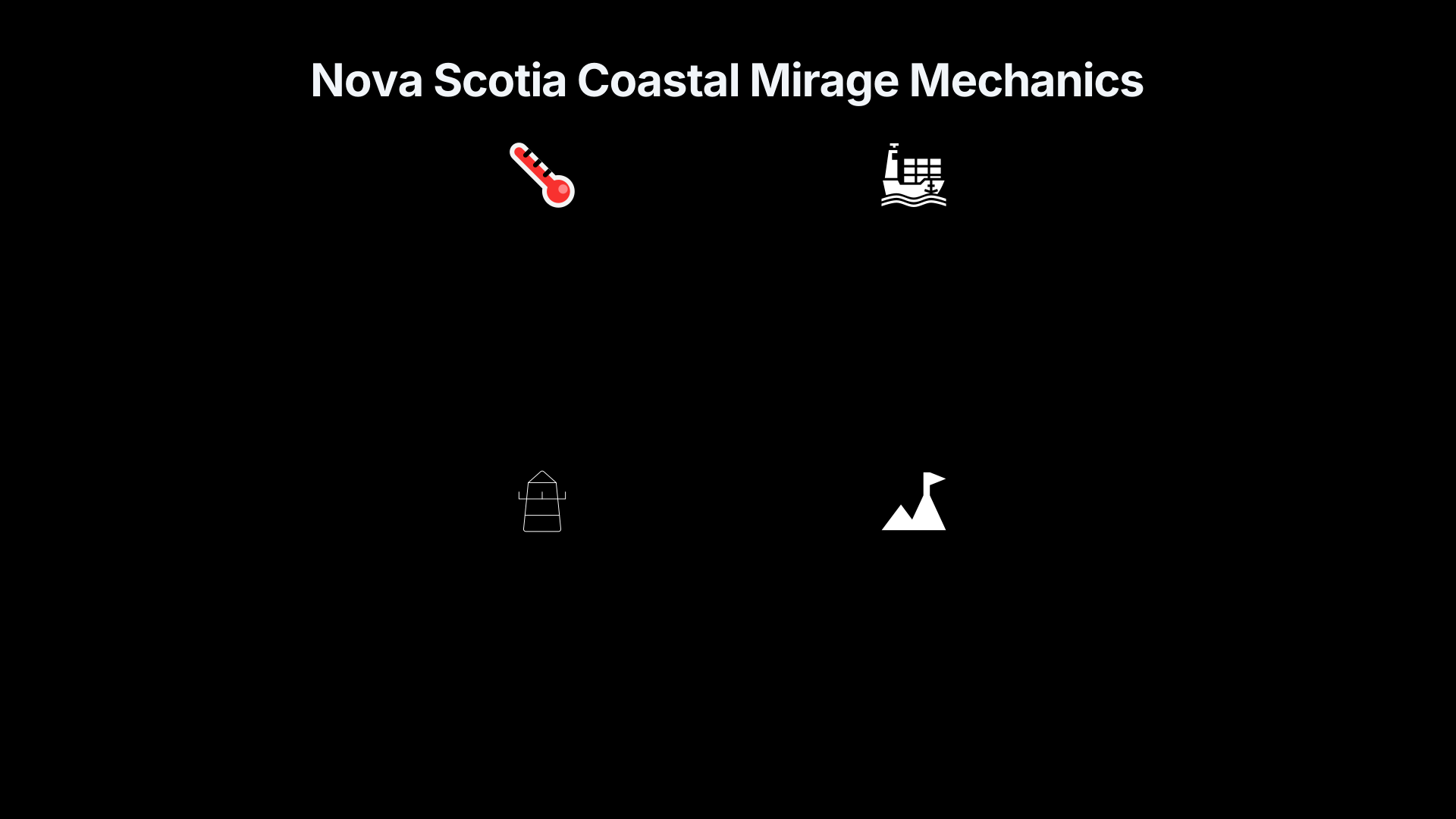
The Atlantic horizon is not a fixed visual boundary. Air temperatures above the ocean can change rapidly with height, especially when cold water sits beneath warmer air or when weather systems move across the coast. These temperature differences bend light, a process known as atmospheric refraction. The result is that distant objects may appear higher, lower or differently shaped than they really are. [Wikipedia]WikipediaOpen source on wikipedia.org.
For someone watching from a beach, harbour or headland at night, this creates a difficult observing environment. A light that seems to be hovering just above the water may actually belong to an object below the apparent horizon. A distant vessel can appear elevated. A celestial object can seem detached from its true position. The observer is seeing a real light source, but not necessarily where it actually is. Earth and Ocean Sciences+2calgary.rasc.ca [eoas.ubc.ca]eoas.ubc.caEarth and Ocean SciencesOptical PhenomenaThe term is looming, when the mirage makes the mountain top appear higher than it is. Also, boat…
This matters in Nova Scotia because many reports originate from fishing communities, coastal roads and shoreline viewpoints where observers are looking almost horizontally through long layers of atmosphere rather than upward through clearer air.
Twinkling stars and planets near the waterline
One of the most common sources of misidentification is a bright star or planet sitting low above the horizon. Objects such as Venus, Jupiter and Sirius can appear surprisingly dramatic when viewed through turbulent coastal air.
Astronomers call the rapid fluctuations in brightness, colour and apparent position “scintillation”, more commonly known as twinkling. When a star is close to the horizon, its light must pass through far more atmosphere than when it is overhead. Turbulence and changing air densities can make the object appear to flash, shift position, flicker between colours or momentarily brighten and dim. [Encyclopedia Britannica+3Astronomy Magazine+3Astronomy Magazine]astronomy.comAstronomy MagazineWhy do some stars appear to twinkle while others don't?7 May 2026 — First, stars close to the horizon twinkle more beca…
For an observer unfamiliar with the effect, a bright low star can seem remarkably active:
- It may appear to move slightly left and right.
- It may seem to rise or fall above the water.
- White light can flash red, blue, green or orange.
- The object can appear larger than expected.
- It may seem to pulse or signal deliberately. [Wikipedia+2Primitive Proton]WikipediaMarch 4, 2026 — Twinkling, also called scintillation, is a generic term for variations in apparent brightness, colour, or position of a d…
Because stars are effectively point sources of light, atmospheric distortion affects them strongly. Planets usually appear steadier, but when very low on the horizon even planets can shimmer and flash enough to attract UFO reports. [Encyclopedia Britannica+2Almanac]britannica.comEncyclopedia BritannicaWhy Do Stars Twinkle? | Stars, Astronomy, & FactsStars twinkle due to turbulence in Earth's atmosphere as starligh…
This is one reason investigators frequently compare sighting times with astronomical records before treating a coastal light as anomalous.
Meteors versus prolonged sightings
Meteors create a different type of confusion. Nova Scotia’s coastal setting provides dark skies and broad views of the horizon, making bright fireballs especially noticeable.
A meteor can appear to plunge towards the ocean, giving the impression that an object has crashed into the water. Witnesses separated by many kilometres may report the same event and interpret it differently. One person may see a fast-moving object; another may describe a descending light; a third may believe something entered the sea.
The key distinction is duration. Most meteors are visible for only a few seconds. Even exceptionally bright fireballs generally produce brief observations. By contrast, many classic coastal UFO reports involve lights observed for several minutes or longer. In those cases, investigators usually look first at stars, planets, aircraft, marine traffic or atmospheric effects rather than meteors.
The distinction is not always obvious in real time. Human estimates of duration are often unreliable during surprising events, particularly at night and over featureless water.
Mirage and refraction effects over coastal water
The most dramatic horizon distortions occur when layers of warm and cold air create strong refraction above the sea.
A superior mirage forms when colder air lies beneath warmer air. Light bends downward through the temperature inversion, causing distant objects to appear elevated above their true position. Ships can seem to float in mid-air. Coastlines may appear stretched upward. Lights near the horizon can appear detached from the surface. [Skybrary+2Earth and Ocean Sciences]skybrary.aeroFata MorganaA superior mirage occurs when there is a temperature inversion; the air below the line of sight is colder than the ai…
Under stronger conditions, a complex mirage known as a Fata Morgana can occur. These events can produce multiple distorted images stacked above one another, sometimes changing shape rapidly as atmospheric layers shift. Ordinary vessels, islands or distant structures may become almost unrecognisable. [Wikipedia]WikipediaFata Morgana (mirageFata Morgana (mirage
Although Fata Morgana displays are often associated with folklore and “ghost ship” stories, they are well-understood optical phenomena. Modern examples continue to be photographed around coastlines worldwide, where ships appear suspended above the sea or transformed into strange towers and shapes. [Wikipedia+2The Times]WikipediaFata Morgana (mirageFata Morgana (mirage
For Nova Scotia observers, the important point is that these effects are not theoretical. The province’s long coastline, cold offshore waters and rapidly changing weather provide exactly the kind of environment in which strong marine refraction can develop.
Why these explanations matter in UFO investigations
A common mistake in UFO debates is treating an ordinary explanation as an accusation that witnesses were careless or dishonest. Horizon effects show why that approach fails.
A witness can accurately report a hovering light, a flashing object or something apparently rising from the sea and still be describing an event created by atmospheric conditions rather than an unknown craft. The observation may be genuine even if the interpretation is mistaken.
This is particularly relevant in Nova Scotia, where many historical reports involve lights near the ocean horizon. Investigators who ignore atmospheric optics risk exaggerating a case. Investigators who assume every report is merely a star risk overlooking genuinely unusual events. The most reliable approach is to reconstruct viewing conditions carefully: the observer’s location, weather, sea conditions, astronomical objects present, and any evidence for temperature inversions or strong refraction.
That balanced approach explains why some coastal sightings become more convincing after investigation while others weaken substantially. Horizon effects do not solve every report, but they remain one of the most important ordinary mechanisms behind strange lights seen over Nova Scotia’s coastal waters.
Amazon book picks
Further Reading
Books and field guides related to Why the sea horizon tricks the eye. Use these as the next step if you want deeper reading beyond the article.
NightWatch
Explains how stars, planets, and atmospheric conditions affect what observers see near the horizon.
The Cambridge Encyclopedia of Meteorites
Useful for distinguishing brief meteor events from longer-lasting horizon sightings.
Weather by the Numbers
Provides context for temperature layers, air masses, and conditions that produce refraction and mirages.
Peterson Field Guide to Stars and Planets
First published 1999. Subjects: Planets, Stars, Stars, atlases, Astronomy.
eBay marketplace picks
Marketplace Samples
Example marketplace items related to this page. Use the search link to explore similar finds on eBay.
Endnotes
-
Source: Wikipedia
Link: https://en.wikipedia.org/wiki/Horizon -
Source: calgary.rasc.ca
Title: RAS C Calgary Centre
Link: https://calgary.rasc.ca/horizon.htmSource snippet
RASC Calgary Centre - The Horizon25 Apr 2007 — Atmospheric refraction near the ground produces mirages and can make distant objects appea...
-
Source: Wikipedia
Link: https://en.wikipedia.org/wiki/Looming_and_similar_refraction_phenomenaSource snippet
Mirages show an extra image or images of the miraged object, while looming, towering, stooping...Read more...
-
Source: astronomy.com
Link: https://www.astronomy.com/observing/why-do-some-stars-appear-to-twinkle-while-others-dont/Source snippet
Astronomy MagazineWhy do some stars appear to twinkle while others don't?7 May 2026 — First, stars close to the horizon twinkle more beca...
Published: May 2026
-
Source: astronomy.com
Title: simply scintillating
Link: https://www.astronomy.com/science/simply-scintillating/Source snippet
Astronomy MagazineSimply Scintillating | Astronomy.com18 May 2023 — Twinkling, the common term for stellar “scintillation,” refers to tin...
Published: May 2023
-
Source: Wikipedia
Link: https://en.wikipedia.org/wiki/Astronomical_seeingSource snippet
Astronomical seeingIn astronomy, seeing is the degradation of the image of an astronomical object due to turbulence in the atmosphere...
-
Source: britannica.com
Link: https://www.britannica.com/science/Why-Do-Stars-TwinkleSource snippet
Encyclopedia BritannicaWhy Do Stars Twinkle? | Stars, Astronomy, & FactsStars twinkle due to turbulence in Earth's atmosphere as starligh...
-
Source: Wikipedia
Link: https://en.wikipedia.org/wiki/TwinklingSource snippet
March 4, 2026 — Twinkling, also called scintillation, is a generic term for variations in apparent brightness, colour, or position of a d...
Published: March 4, 2026
-
Source: almanac.com
Title: why do stars twinkle and why planets dont
Link: https://www.almanac.com/why-do-stars-twinkle-and-why-planets-dontSource snippet
Why Do Stars Twinkle (and Why Planets Don't)?Jan 16, 2026 — Stars twinkle because their light passes through Earth's atmosphere, which is...
-
Source: skybrary.aero
Link: https://skybrary.aero/articles/fata-morganaSource snippet
Fata MorganaA superior mirage occurs when there is a temperature inversion; the air below the line of sight is colder than the ai...
-
Source: Wikipedia
Title: Fata Morgana (mirage)
Link: https://en.wikipedia.org/wiki/Fata_Morgana_%28mirage%29 -
Source: Wikipedia
Title: Mirage of astronomical objects
Link: https://en.wikipedia.org/wiki/Mirage_of_astronomical_objectsSource snippet
Mirage of astronomical objectsThe Novaya Zemlya effect is a mirage caused by high refraction of sunlight between atmospheric thermocli...
-
Source: astronomy.com
Title: Why do some stars appear to flash a variety of different
Link: https://www.astronomy.com/science/why-do-some-stars-appear-to-flash-a-variety-of-different-colors-when-you-look-at-them-through-a-telescope/Source snippet
May 18, 2023 — Earth's atmosphere will bend some colors from especially bright stars more so than others, which makes the source look lik...
Published: May 18, 2023
-
Source: eoas.ubc.ca
Link: https://www.eoas.ubc.ca/courses/atsc113/sailing/met_concepts/10-met-local-conditions/10f-optical-phenomena/Source snippet
Earth and Ocean SciencesOptical PhenomenaThe term is looming, when the mirage makes the mountain top appear higher than it is. Also, boat...
-
Source: primitiveproton.com
Title: Few stars, such as Betelgeuse, Sirius, and Rigel
Link: https://primitiveproton.com/atmospheric-scintillation-why-stars-twinkle-and-planets-dont/Source snippet
Primitive ProtonAtmospheric Scintillation: Why Stars Twinkle And Planets...It is an astronomical term for changes in stars' brightness o...
-
Source: thetimes.com
Title: The Times Seeing is believing
Link: https://www.thetimes.com/comment/register/article/seeing-is-believing-or-is-it-9r0bnpvh8Source snippet
A boat operator, Mike Hancock, observed what initially appeared to be a large ship, but it morphed into bizarre shapes like "fuzzy tall t...
-
Source: ebsco.com
Link: https://www.ebsco.com/research-starters/science/mirageSource snippet
Mirage | Science | Research StartersA mirage is an optical illusion resulting from the refraction of light in the atmosphere, primarily o...
Additional References
-
Source: reddit.com
Link: https://www.reddit.com/r/askastronomy/comments/1fhig5z/a_flickering_object_in_the_northern_hemisphere/Source snippet
A “flickering” object in the northern hemisphere: r/askastronomyBright stars twinkle more, and stars near the horizon twinkle more. They...
-
Source: astroshop.eu
Link: https://www.astroshop.eu/magazine/practical-tips/peter-s-problem-solvers/colour-fringing-on-low-lying-planets/i%2C1484Source snippet
Colour fringing on low-lying planetsColour fringing on planets is very common, even with expensive telescopes. The reason for this and th...
-
Source: facebook.com
Link: https://www.facebook.com/groups/AllAboutSeaBright/posts/5157402844398581/Source snippet
superior mirage of cargo ship over oceanSuperior mirage A strange optical illusion over the ocean tonight - cargo ship appearing to float...
-
Source: thesun.co.uk
Title: The Sun Incredible mind-bending pic shows ship ‘floating in mid-air’ off Greece
Link: https://www.thesun.co.uk/news/27828081/ship-floating-mid-air-greece-optical-illusion/Source snippet
The image, captured by Greek photographer Nontas Kalogiann, depicts the ship Achilleas seemingly hovering above the horizon, an optical i...
-
Source: astronomy.stackexchange.com
Title: what is this rapidly twinkling red blue and white star i saw
Link: https://astronomy.stackexchange.com/questions/23320/what-is-this-rapidly-twinkling-red-blue-and-white-star-i-sawSource snippet
is this rapidly twinkling red, blue, and white star I saw?Oct 27, 2017 — Last night, I was on my balcony at 1AM (PST) and I looked up and...
-
Source: rmets.onlinelibrary.wiley.com
Link: https://rmets.onlinelibrary.wiley.com/doi/10.1002/wea.3406Source snippet
wiley.comTitanic's mirage, part 3: A case of mistaken identity, low‐lying...26 Dec 2018 — A narrow band at the horizon is a Fata Morgana...
-
Source: reddit.com
Link: https://www.reddit.com/r/Optics/comments/ns7exy/just_found_this_excellent_video_that_combines/Source snippet
spheric refraction - looming, lofting, fata Morgana, etc - with partial...
-
Source: researchgate.net
Title: Light refraction in the earth’s atmosphere II
Link: https://www.researchgate.net/publication/375267222_Light_refraction_in_the_earth%27s_atmosphere_II_Inferior_mirages_regions_for_images_and_objects_observationSource snippet
Inferior mirages6 Nov 2023 — In the present work, we analyze the different regions that are configured in a vertical plane for the visual...
-
Source: earthsky.org
Title: flashing star autumn capella arcturus sirius
Link: https://earthsky.org/astronomy-essentials/flashing-star-autumn-capella-arcturus-sirius/Source snippet
Flashing star in autumn? Here are 3 candidatesOct 3, 2024 — The bright star Capella in the constellation Auriga the Charioteer is our #1...
-
Source: facebook.com
Link: https://www.facebook.com/AstroKirsten/posts/why-do-stars-twinkle-but-planets-dont-heres-whats-going-oneven-though-stars-are-/1343560821104506/Source snippet
f how much thermal turbulence is in the atmosphere at the time. Yet...
Topic Tree