Within Pilot Lights
Why Did the Lights Not Show Up?
The missing TCAS return is important, but it does not turn cockpit lights into a confirmed object or craft.
On this page
- What TCAS is built to detect
- Why some lights may leave no cockpit warning
- What the missing return can and cannot prove
Page outline Jump by section
Introduction
One of the most discussed details in the Yellowknife pilot report is that the lights seen by the crew of Canadian North flight 5071 did not appear on the aircraft’s Traffic Collision Avoidance System (TCAS). To some readers, that absence sounds like evidence that the lights were something extraordinary. In reality, the missing TCAS return is important, but it does not prove that the crew saw a structured object, an aircraft, or an unknown craft.
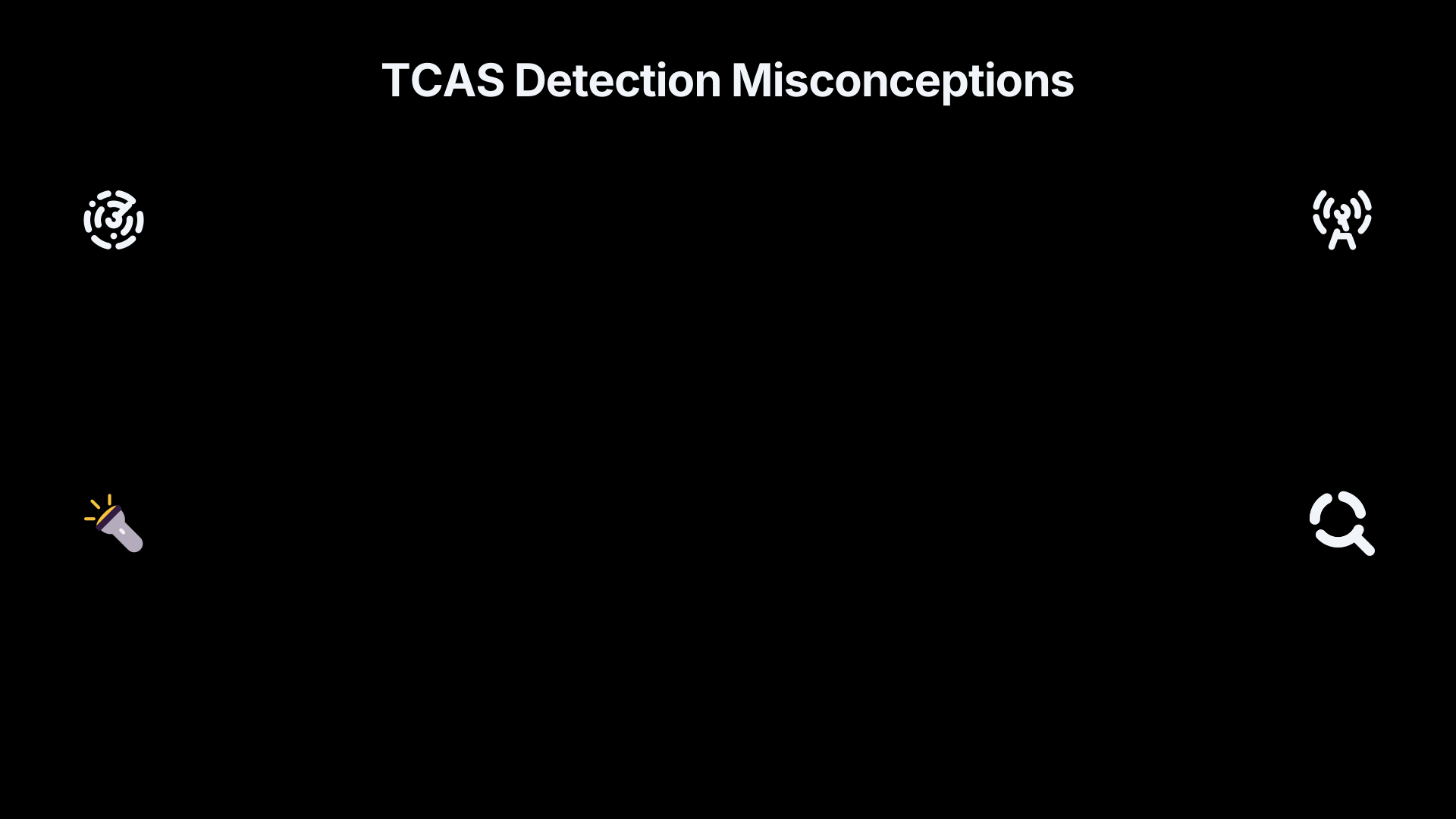 The key point is that TCAS is not a general-purpose detector of everything visible in the sky. It is a specialised aviation safety system designed to detect and track aircraft that are transmitting the right electronic signals. A light can be clearly visible to pilots and still leave no trace on TCAS. Understanding that distinction helps explain why the Yellowknife case remains uncertain rather than confirmed. [Cabin Radio+2Federal Aviation Administration]cabinradio.caCabin RadioCanadian North crew reports 'lights in sky' over YellowknifeFebruary 11, 2023 — 11 Feb 2023 — Flight 5071: Yeah, we're looking…
Why Did the Lights Not Show Up?
During the radio exchange near Yellowknife in January 2023, the crew reported seeing two bright lights moving above them. They specifically told air traffic control that the lights were not showing on TCAS, while controllers also reported no corresponding radar traffic. The pilots were sufficiently puzzled to ask whether known aircraft were operating nearby. [Cabin Radio]cabinradio.caCabin RadioCanadian North crew reports 'lights in sky' over YellowknifeFebruary 11, 2023 — 11 Feb 2023 — Flight 5071: Yeah, we're looking…
That combination—visible lights but no TCAS indication—is unusual enough to attract attention, yet it has several possible explanations. The absence of a TCAS target narrows the possibilities, but it does not identify what the lights were.
What TCAS Is Built to Detect
TCAS, known internationally as an Airborne Collision Avoidance System (ACAS), is designed to prevent mid-air collisions. It works by interrogating nearby aircraft transponders and analysing their replies. If another aircraft is equipped with a functioning transponder, TCAS can display it and, if necessary, provide collision warnings or avoidance instructions. [Skybrary+3Federal Aviation Administration+3Transport Canada]faa.govFederal Aviation AdministrationThe secondary purpose of the…Read more…
A crucial limitation is that TCAS does not detect every object in the sky. It depends on electronic cooperation from the target. Transport Canada guidance explicitly notes that aircraft without operating transponders are effectively invisible to TCAS-equipped aircraft. European and aviation-safety guidance describe the same limitation. [EUROCONTROL+3Transport Canada+3EUROCONTROL]tc.canada.caTransport Canada Aircraft Certification Staff Instruction (ACSIAS I is a functional subset of TCAS II in that it provides Traffic…
In practical terms, TCAS is looking for transponder replies, not for lights.

Why Some Lights May Leave No Cockpit Warning
Several categories of phenomena can be visible from a cockpit without producing a TCAS alert.
Natural atmospheric or astronomical sources. Bright planets, stars near the horizon, atmospheric reflections, ice-crystal effects, and auroral activity can appear surprisingly bright or mobile from a moving aircraft. Because they are not aircraft, they generate no transponder signals and therefore no TCAS target. The Northwest Territories’ northern latitude makes unusual sky effects more common than in many southern regions. [Federal Aviation Administration]faa.govThe secondary purpose of the…Read more…
Aircraft with no usable transponder return. A real aircraft can fail to appear on TCAS if its transponder is not operating correctly, is switched off, or is not providing the necessary information. Aviation guidance repeatedly identifies this as a known limitation of collision-avoidance systems. [Transport Canada+2EUROCONTROL]tc.canada.caTransport Canada Aircraft Certification Staff Instruction (ACSIAS I is a functional subset of TCAS II in that it provides Traffic…
Objects that are not aircraft at all. Satellites, rocket stages reflecting sunlight, or other distant light sources may be visible under some conditions yet produce no aviation-system response because they are outside the system’s design envelope. TCAS is not intended to classify or display such objects. [Federal Aviation Administration]faa.govThe secondary purpose of the…Read more…
Visual perception effects. At night, especially from a moving aircraft, estimating distance, altitude, and motion is difficult. Two distant lights can appear to manoeuvre relative to one another because of viewing angle changes, atmospheric conditions, or the observer’s own motion. Such effects can create the impression of movement without any nearby aircraft being present. [Cabin Radio]cabinradio.caCabin RadioCanadian North crew reports 'lights in sky' over YellowknifeFebruary 11, 2023 — 11 Feb 2023 — Flight 5071: Yeah, we're looking…
What the Missing Return Can and Cannot Prove
The absence of a TCAS target does provide useful information. It suggests that the lights were not behaving like a nearby, transponder-equipped aircraft that the system could identify. That is a legitimate observation and one reason the crew found the sighting noteworthy. [Cabin Radio]cabinradio.caCabin RadioCanadian North crew reports 'lights in sky' over YellowknifeFebruary 11, 2023 — 11 Feb 2023 — Flight 5071: Yeah, we're looking…
However, the missing return cannot prove that the lights represented an unknown craft. TCAS was never designed to answer that question. A non-detection only tells investigators that the observed source did not generate the kind of signal TCAS expected to receive. It does not reveal whether the source was a distant aircraft, an atmospheric effect, a celestial object, a satellite reflection, a transponderless target, or something else entirely. [Skybrary+3Federal Aviation Administration+3Transport Canada]faa.govFederal Aviation AdministrationThe secondary purpose of the…Read more…
This distinction is often lost in UFO discussions. A lack of electronic confirmation is not the same thing as evidence for an extraordinary explanation. It simply removes one possible identification.

Why This Matters in the Yellowknife Case
The Yellowknife report remains interesting because it involved trained aviation observers, an active air traffic control conversation, and a contemporaneous record of what the crew saw. The TCAS detail adds to the mystery by showing that the lights were not immediately identified through standard cockpit systems. [Cabin Radio]cabinradio.caCabin RadioCanadian North crew reports 'lights in sky' over YellowknifeFebruary 11, 2023 — 11 Feb 2023 — Flight 5071: Yeah, we're looking…
Yet the same detail also limits what can be claimed. The pilots themselves did not report a collision threat, a close encounter, or a confirmed aircraft. Controllers could not identify corresponding traffic, and the public record has not produced evidence that the lights were a definite physical craft. The missing TCAS return therefore supports a cautious conclusion: the sighting was unexplained in the moment, but it did not provide proof of an unknown vehicle. [Cabin Radio+2Transport Canada]cabinradio.caCabin RadioCanadian North crew reports 'lights in sky' over YellowknifeFebruary 11, 2023 — 11 Feb 2023 — Flight 5071: Yeah, we're looking…
Within the broader history of unusual aerial reports in the Northwest Territories, that makes the case a useful example of aviation uncertainty. The lights were visible. The crew took them seriously enough to report. The aircraft systems did not identify them. But the absence of a TCAS hit remains a clue, not a solution.
Amazon book picks
Further Reading
Books and field guides related to Why Did the Lights Not Show Up?. Use these as the next step if you want deeper reading beyond the article.
The Report on Unidentified Flying Objects
Examines cases where available detection data was limited.
eBay marketplace picks
Marketplace Samples
Example marketplace items related to this page. Use the search link to explore similar finds on eBay.
Endnotes
-
Source: tc.canada.ca
Title: Transport Canada Aircraft Certification Staff Instruction (ACSI)
Link: https://tc.canada.ca/en/aviation/reference-centre/aircraft-certification-guidance-advisory-materials-pre-2007/aircraft-certification-staff-instruction-acsi-8Source snippet
AS I is a functional subset of TCAS II in that it provides Traffic...
-
Source: eurocontrol.int
Link: https://www.eurocontrol.int/system/acasSource snippet
Airborne collision avoidance system (ACAS|TCAS)ACAS does not detect non-transponder equipped aircraft or aircraft with a non-o...
-
Source: skybrary.aero
Link: https://skybrary.aero/articles/airborne-collision-avoidance-system-acasSource snippet
ice for traffic without altitude reporting transponder...
-
Source: eurocontrol.int
Link: https://www.eurocontrol.int/archive_download/all/node/8858Source snippet
secondary radars. Therefore, pilots must...Read more...
-
Source: skybrary.aero
Link: https://skybrary.aero/video/tcas-environment-aircraft-must-operate-their-altitude-reporting-transponderSource snippet
TCAS II displays should not be used for Self-Separation Aircrew should...
-
Source: cabinradio.ca
Link: https://cabinradio.ca/120760/news/yellowknife/canadian-north-crew-reports-lights-in-sky-over-yellowknife/Source snippet
Cabin RadioCanadian North crew reports 'lights in sky' over YellowknifeFebruary 11, 2023 — 11 Feb 2023 — Flight 5071: Yeah, we're looking...
Published: February 11, 2023
-
Source: faa.gov
Title: Federal Aviation Administration
Link: https://www.faa.gov/documentlibrary/media/advisory_circular/tcas%20ii%20v7.1%20intro%20booklet.pdfSource snippet
The secondary purpose of the...Read more...
-
Source: canadiannorth.com
Title: Canadian North
Link: https://canadiannorth.com/Source snippet
WelcomeBook a flight, plan your trip, check-in destinations, flight schedule, flight status, manage my trip, route map, travel info, acce...
-
Source: tsunamiair.com
Link: https://tsunamiair.com/airplane/tcasSource snippet
Traffic Alert and Collision Avoidance System (TCAS)15 Mar 2026 — TCAS does not detect aircraft that are not transponder equipped, nor air...
Additional References
-
Source: canadiannorth.com
Link: https://canadiannorth.com/travel-info/before-you-fly/ -
Source: easemytrip.com
Link: https://www.easemytrip.com/flights/canadian-north-flight-status/Source snippet
Canadian North Flight StatusCheck the live status of Canadian North flights with real-time updates for the domestic & international desti...
-
Source: tarmacview.com
Link: https://www.tarmacview.com/glossary/tcas/Source snippet
TCAS (Traffic Alert and Collision Avoidance System)TCAS cannot detect aircraft without functioning transponders, has no lateral (turn) av...
-
Source: scribd.com
Link: https://www.scribd.com/document/494710044/Tcas-SolutionSource snippet
TCAS Overview and Functionality | PDFThis document discusses the development of TCAS, a collision avoidance system used in aircraft. TCAS...
-
Source: ll.mit.edu
Title: tcas system preventing midair collisions harman ja 6399
Link: https://www.ll.mit.edu/sites/default/files/publication/doc/tcas-system-preventing-midair-collisions-harman-ja-6399.pdfSource snippet
mit.eduTCAS: a system for preventing midair collisionsBecause aircraft equipped with Mode-S transponders are tracked by TCAS in Mode S, t...
-
Source: facebook.com
Title: TCA S DOESN’T ASK ATC… IT ACTS It feels like pilots are
Link: https://www.facebook.com/61558804422315/posts/tcas-doesnt-ask-atc-it-actsit-feels-like-pilots-are-always-waiting-for-instructi/122220114506293480/Source snippet
TCAS makes it rare. What TCAS Actually Does TCAS: ✓ Detects nearby transponder-equipped aircraft ✓ Calculates closing speed & trajectory...
-
Source: instagram.com
Link: https://www.instagram.com/reel/DV0wZ37CoBV/Source snippet
plane. ✨ Sometimes the adventure begins before you even land. ✈️...
-
Source: facebook.com
Link: https://www.facebook.com/MentourPilot/posts/what-happens-when-tcas-gives-a-false-warning-this-critical-technology-tells-pilo/1373586887468022/Source snippet
they are supposed to climb or descend to avoid mid-air crashes...
-
Source: youtube.com
Link: https://www.youtube.com/watch?v=Q6JgyhoCyi8Source snippet
STRANGE LIGHTS IN THE SKY | Pilots UFO Report at High Altitude...
-
Source: youtube.com
Link: https://www.youtube.com/watch?v=yuwQMa0xL28Source snippet
"CLIMB NOW!" How Aircraft Anti-Collision systems work...
Topic Tree