Within BC UFOs
When BC UFO Reports Enter Aviation Channels
Airport-adjacent and aviation reports matter because they add safety context, but they still need careful checks against known traffic and weather.
On this page
- Pilot and airport adjacent reports
- CADORS and modern reporting paths
- Aircraft, drones and safety explanations
Page outline Jump by section
Introduction
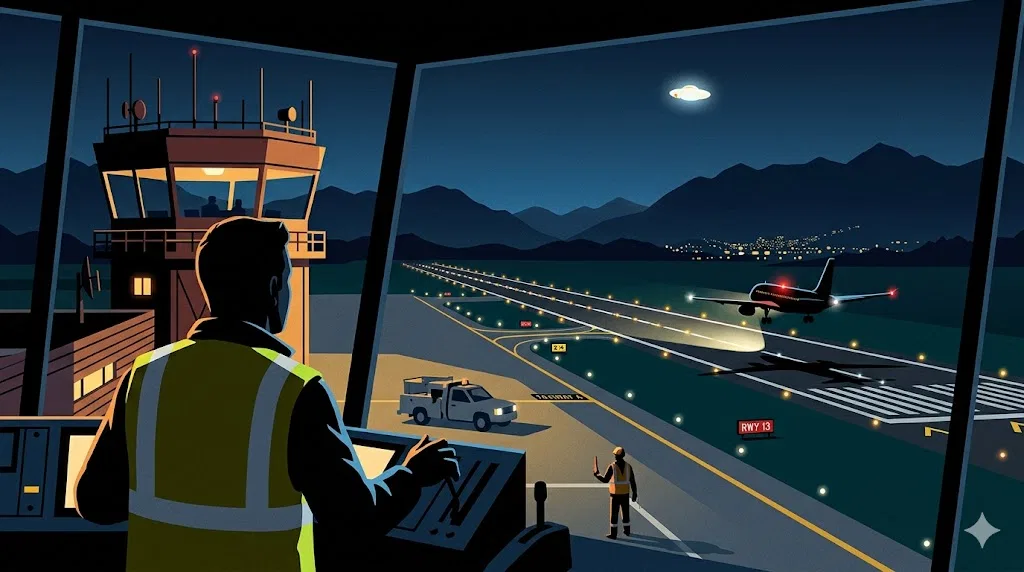
British Columbia’s aviation-linked UFO record is best understood as a safety-reporting story, not a catalogue of proven mysteries. When pilots, air traffic controllers, airport staff, police or the public report an unidentified object that might affect flight safety, the report can enter Canadian aviation channels, especially Transport Canada’s Civil Aviation Daily Occurrence Reporting System, known as CADORS. That gives some BC cases a firmer paper trail than ordinary civilian sightings, but it does not make them extraordinary by itself. CADORS entries are preliminary, often brief, and may describe balloons, drones, meteors, satellites, aircraft, radar returns, weather effects or genuinely unidentified observations. Transport Canada explicitly warns that “UFO” in CADORS should not be read as extraterrestrial; it can cover remotely piloted aircraft systems, balloons, meteors, weather phenomena and birds. [Transport Canada]tc.canada.caTransport Canada4. High Altitude Object IncidentsTransport Canada4. High Altitude Object Incidents
For British Columbia, the value of airport and pilot reports is practical. They show how sightings move from the sky into official Canadian systems: a crew sees something, air traffic services may receive the call, NAV CANADA may file an aviation occurrence report, Transport Canada may publish a CADORS record, and a small number of higher-risk cases may be passed to other bodies. That makes these reports important to BC UFO history, but mainly because they reveal how uncertainty is managed near flight paths, mountains, coastal approaches and busy airports.
Why aviation reports carry weight, but not certainty
Pilot and airport-adjacent UFO reports tend to attract more attention than casual ground sightings because the witnesses are trained observers operating in a safety-critical environment. A flight crew can usually distinguish many ordinary aircraft behaviours, estimate relative altitude better than a casual witness, and communicate quickly with air traffic control. In British Columbia, this matters because the province includes Vancouver International Airport, regional airports at Victoria, Kelowna, Abbotsford, Prince George, Terrace and elsewhere, coastal seaplane traffic, helicopter operations, mountain routes and trans-Pacific corridors.
That does not mean pilots are immune to misidentification. Cockpit sightings can be difficult precisely because the aircraft is moving, the observer is looking through glass, and the object may be seen near the horizon, in twilight, through cloud layers or above reflective water. A light that seems to manoeuvre may be an aircraft on another track, a satellite flare, a meteor fragment, a drone, a balloon, or a reflection. The stronger aviation reports are therefore not the ones with the strangest wording, but the ones with enough supporting detail to test: time, position, altitude, heading, weather, radar status, radio response, known traffic, and whether other aircraft or controllers saw the same thing.
CADORS is useful because it preserves some of this operational context. Transport Canada describes CADORS as the main Canadian source of aviation occurrence information, launched in 1985 to provide timely information about civil aviation occurrences and to capture reports required from air traffic services under Canadian Aviation Regulations. The system is used to identify hazards and system deficiencies, not to prove the nature of every unusual light or object. [Transport Canada]tc.canada.caTransport Canada The Civil Aviation Daily Occurrence Reporting System (CADORSTransport Canada The Civil Aviation Daily Occurrence Reporting System (CADORS
The key caution is that CADORS is not a final investigative verdict. Transport Canada says CADORS information is preliminary and can be updated as further information or corrections become available; its CADORS manual also states that the information should be treated as preliminary, unsubstantiated and subject to change, with the Transportation Safety Board of Canada being the official source of aviation accident and incident data. [Transport Canada]tc.canada.caTransport Canada The Civil Aviation Daily Occurrence Reporting System (CADORSTransport Canada The Civil Aviation Daily Occurrence Reporting System (CADORS

How a BC sighting enters Canadian aviation channels
Aviation-linked UFO reports in British Columbia usually matter because of the route they take, not because they are labelled “UFO”. Canada’s current process is more prosaic than many readers expect. The Office of the Chief Science Advisor’s Sky Canada Project explains that pilots typically report UAP sightings to the nearest air traffic control tower, flight service station or other air traffic unit. Those units can file an Aviation Occurrence Report with NAV CANADA, which is then sent to Transport Canada’s CADORS team for assessment and processing. Public reports can also reach Transport Canada through the online aviation incident reporting application if they meet inclusion criteria. [Science.gc.ca]science.gc.caManagement of Public Reporting of Unidentified Aerial Phenomena in CanadaManagement of Public Reporting of Unidentified Aerial Phenomena in Canada
Once a report is in CADORS, Transport Canada analysts classify it under event categories based on the information available. For UAP-like events, Sky Canada lists three possible CADORS pathways: “Weather Balloon, Meteor, Rocket, UFO and Intelligence Sighting”; “Laser Interference”; or “Other Operational Incidences”. This is one reason BC readers should be careful with headlines. A report can be aviation-relevant without being a classic “flying saucer” case, and a CADORS event category can group together quite different hazards. [Science.gc.ca]science.gc.caManagement of Public Reporting of Unidentified Aerial Phenomena in CanadaManagement of Public Reporting of Unidentified Aerial Phenomena in Canada
NAV CANADA is central to the reporting chain. Transport Canada’s own Aviation Safety Letter says NAV CANADA provides about 80 per cent of the aviation occurrence information used to create CADORS records, usually through aviation occurrence reports. Other possible sources include the Transportation Safety Board, the RCMP, aircraft operators and other government agencies. [Transport Canada]tc.canada.caTransport Canada The Civil Aviation Daily Occurrence Reporting System (CADORSTransport Canada The Civil Aviation Daily Occurrence Reporting System (CADORS
For British Columbia, this means a sighting can move through several Canadian institutions before it becomes visible to the public. A Vancouver-area crew might call air traffic control; a remote coastal report might involve a flight service station; a ground witness near an aerodrome might contact airport authorities, the RCMP or Transport Canada. None of these routes turns the object into a solved case. They simply make the report part of aviation safety documentation.
The Terrace radar case shows both the value and limits of CADORS
One of the most useful recent BC examples is the 18 July 2024 Terrace case, later highlighted in the Canadian UFO Survey’s higher-quality 2024 appendix. The report was associated with CADORS 2024P2092 and described an “unidentified aircraft” seen on radar in the Terrace control zone. According to the summary, the weather at the time was special visual flight rules, with visibility of 1½ miles, and an aircraft identified as ASP675 was on approach to Runway 13. The unidentified aircraft did not answer radio calls; ASP675 was advised of its position and direction of travel before the radar target disappeared. [Canadian UFO Report]canadianuforeport.comCanadian UFO Report Microsoft WordCanadian UFO ReportMicrosoft Word - 2024Surveyessay…
This is a better case for an aviation page than a dramatic lights-in-the-sky anecdote because it involves a control zone, radar, an aircraft on approach and an apparent failure to respond to radio calls. Those details make it relevant to safety even if the object was never identified publicly. The case also shows why “unidentified” should be read narrowly. A radar return that vanishes in poor visibility may represent an aircraft with an equipment or communication issue, a radar artefact, a transponder-related ambiguity, weather clutter, a bird flock or another target whose identity was not established in the public summary. The available public information is not enough to choose among those possibilities.
What the Terrace report contributes to BC UFO history is not proof of a mystery craft. It shows that some BC cases enter the record because they intersect with controlled airspace and operational decision-making. The practical question was not “is this alien?” but “is there something in or near the control zone that an approaching aircraft should know about?” That is a different kind of UFO significance: unresolved at the public-record level, but important because it affected a live aviation environment.
The Terrace case also illustrates why CADORS-linked reports need careful reading. A public summary can preserve the incident outline while omitting the raw radar data, controller workload, subsequent checks, equipment status and any later internal clarification. For a reader, the honest conclusion is that the event is noteworthy and unresolved in the accessible record, but not evidentially strong enough to support a more exotic claim.
Airport-adjacent BC reports are often safety reports first
British Columbia’s airport-adjacent cases sit at the junction of UFO interest and ordinary aviation risk. The province’s geography increases the chance of ambiguous sightings. Coastal haze, mountain horizons, steep approach paths, water reflections and broken cloud can make distance and movement difficult to judge. The Vancouver Flight Information Region includes major centres such as Vancouver, Kelowna, Abbotsford and Victoria, and also covers challenging terrain including the Rocky Mountains and Coast Mountains. [Flite Lab]flitelab.files.wordpress.comFlite Lab VANCOUVER FLIGHT INFORMATION REGION UAV BESTFlite LabVANCOUVER FLIGHT INFORMATION REGION UAV BEST…August 7, 2015 — 6 Aug 2015 — Vancouver FIR also has airports serving major cent…
Vancouver International Airport also matters because of traffic density. YVR described itself in 2026 as Canada’s second busiest airport, and its surrounding airspace sits near seaplane routes, helicopter movements, cargo traffic, transborder and international routes, and urban drone risk. [YVR News]news.yvr.camarks record breaking yearYVR NewsYVR breaks all-time cargo and passenger records in 2025February 3, 2026 — 3 Feb 2026 — YVR's 2025 passenger and cargo results ref… A strange light near Vancouver, Richmond, the Fraser River, the Strait of Georgia or Vancouver Island therefore has more possible aviation explanations than a witness might realise: arriving aircraft, departing aircraft, holding traffic, medevac helicopters, floatplanes, training flights, survey aircraft, drones, satellites seen from a moving aircraft, or reflections from the water and cloud.
Transport Canada’s own airport and aerodrome safety guidance frames this as a hazard-management issue. It says CADORS tracks airport or aerodrome incidents that could affect aviation safety, and that reporting helps identify and address hazards. It also directs high-profile or critical incidents to Transport Canada’s Aviation Operations Centre. [Transport Canada]tc.canada.careport incident affecting airport aerodrome safetyreport incident affecting airport aerodrome safety
That safety framing should shape how BC UFO cases are interpreted. A report near an airport deserves attention because unidentified traffic, drones, lasers, balloons or birds can endanger aircraft. But aviation safety relevance is not the same as anomalous evidence. A weakly described object can be very important operationally for a few minutes and still be scientifically useless afterwards.
CADORS numbers are small compared with ordinary aviation traffic
One misconception is that Canada’s aviation UFO reports form a large hidden dataset. The public record suggests the opposite. Transport Canada’s 2022 question-period note said that CADORS captured unidentified aerial phenomena, but also stressed that further investigation of UAP sightings fell outside Transport Canada’s mandate and that only a much smaller number of UAP-like reports came through Transport Canada than the roughly 1,000 annual public UFO reports sometimes cited in media. A CADORS query from 2010 onward yielded 406 records, and not all were UAP-related sightings. [Open Government Portal]search.open.canada.caOpen Government Portal Question Period NotesOpen Government Portal Question Period Notes
The Sky Canada Project later gave a sharper scale comparison. It noted that a January 2024 review of the CADORS database identified only 17 pilot-reported events in 2023 that could be considered UAPs, about 0.08 per cent of all pilot-reported incidents. It added that when such incidents do not raise serious safety concerns, Canadian authorities generally do not investigate further. [Science.gc.ca]science.gc.caManagement of Public Reporting of Unidentified Aerial Phenomena in CanadaManagement of Public Reporting of Unidentified Aerial Phenomena in Canada
This matters for British Columbia because CADORS-linked UFO reports should not be treated as a hidden flood of aviation mysteries. They are rare within a much larger safety-reporting system that handles thousands of ordinary incidents: runway issues, bird strikes, technical problems, airspace conflicts, weather diversions and communication events. Transport Canada reported that over a five-year period it received an average of 16,750 aviation incident and accident reports annually, about 45 per day. [Transport Canada]tc.canada.caTransport Canada The Civil Aviation Daily Occurrence Reporting System (CADORSTransport Canada The Civil Aviation Daily Occurrence Reporting System (CADORS
The Pacific region is a meaningful part of that system, but not an outlier in a UFO-specific sense. Transport Canada’s 2016–2020 CADORS regional snapshot placed the Pacific region at 15.79 per cent of CADORS incidents and accidents, while Ontario and Quebec together accounted for almost 55 per cent. [Transport Canada]tc.canada.caTransport Canada The Civil Aviation Daily Occurrence Reporting System (CADORSTransport Canada The Civil Aviation Daily Occurrence Reporting System (CADORS For BC UFO history, the result is a measured conclusion: aviation reports exist, some are intriguing, but they are a very small subset of a safety database built for risk management rather than mystery resolution.

Drones, balloons and satellites are now part of the BC UFO filter
Modern BC aviation-linked UFO reports must be checked against three increasingly common explanations: drones, balloons and satellite effects.
Drones are the most obvious safety issue near airports. Transport Canada tells drone operators that they must not fly near an aerodrome in a way that could interfere with aircraft. Unless following an established Transport Canada procedure, operators cannot fly closer than 5.6 kilometres from a certified airport or 1.9 kilometres from a certified heliport. [Transport Canada]tc.canada.caTransport Canada Where to fly your droneTransport Canada Where to fly your drone In a province with urban airports, hospital heliports, floatplane bases and scenic drone users, this rule matters. A “small light” or “object hovering near the approach path” may be a UFO to a witness, but to a pilot it may be an unauthorised remotely piloted aircraft that needs immediate attention.
Balloons became more prominent in Canadian aviation discussion after the 2023 high-altitude object incidents. Transport Canada’s briefing note on high-altitude object incidents says CADORS “UFO” terminology can include balloons and that large unmanned balloons are regulated; the note also says reports may lead to follow-up by Transport Canada, NAV CANADA, the Transportation Safety Board or NORAD depending on the incident. [Transport Canada]tc.canada.caTransport Canada4. High Altitude Object IncidentsTransport Canada4. High Altitude Object Incidents That is directly relevant to BC because high-altitude objects can cross provincial and international boundaries, including western and northern routes.
Satellites are the less intuitive explanation, especially for pilots. A 2024 technical paper on Starlink misidentification found that recently launched satellite trains and changing reflection geometry can generate UAP reports from pilots, and showed how orbital data and aircraft tracking can reconstruct a cockpit sighting. The authors argued that better space-situational-awareness information could reduce aviation confusion and support safety. [arXiv]arxiv.orgOpen source on arxiv.org. This does not explain every BC report, but it gives a serious, testable model for some “multiple lights”, “formation”, “moving oddly” or “above flight level” reports.
For British Columbia, the practical filter is simple: before treating an aviation-linked UFO report as anomalous, check drone restrictions and local aerodromes, balloon and NOTAM information, meteor activity, satellite passes and flares, known aircraft traffic, weather, radar limitations and whether the report came from one witness or multiple independent channels.
What CADORS can and cannot tell readers
CADORS is valuable because it puts some British Columbia sightings into a traceable Canadian framework. It can show that an event was reported close to the time it occurred, that aviation personnel considered it worth logging, that air traffic services were involved, and that a flight crew or controller took some operational action. In strong cases, it can preserve details that civilian UFO databases often lack: control zone, runway, altitude, aircraft on approach, radio calls, weather category, and whether radar was involved.
But CADORS has clear limits. It is not designed to settle public UFO debates. It does not normally publish complete radar data, cockpit recordings, full witness interviews, military checks, satellite analysis or final explanations for low-risk sightings. The record may state that something was unidentified because it was unidentified at the time, not because all ordinary explanations were eliminated. This is especially important in British Columbia, where terrain and weather can make short-lived ambiguity common.
The most responsible way to rank BC aviation-linked cases is therefore by documentation quality rather than strangeness:
- Stronger aviation-safety cases include a known aircraft position, air traffic services involvement, radar or multiple crew reports, and a clear reason the object mattered to flight safety.
- Moderate cases include a pilot or airport report but little independent corroboration, no published radar detail, and no later explanation.
- Weak cases are airport-adjacent anecdotes with vague time, no flight data, no controller involvement and no way to compare the claim against known traffic or sky conditions.
- Likely explained cases match known causes such as drones, balloons, satellites, meteors, planets, aircraft lights, laser interference, reflections or camera artefacts.
That ranking protects both sides of the question. It prevents intriguing reports from being dismissed merely because they sound strange, while also preventing a preliminary safety log from being inflated into evidence of something beyond conventional aviation or atmospheric explanation.
Why these cases matter in British Columbia’s UFO history
Airports, pilots and CADORS-linked reports give British Columbia’s UFO record a practical spine. They connect public curiosity with real Canadian reporting systems, and they show how uncertainty is handled when it intersects with aircraft. That makes them different from purely folkloric or civilian sighting clusters. A light over the Okanagan, a radar return near Terrace, a drone-like object near Vancouver, or a report relayed through the RCMP can matter because someone had to decide whether it posed a risk to an aircraft.
They also help readers avoid two common mistakes. The first is assuming that an official record confirms an extraordinary object. It does not. Library and Archives Canada’s historical UFO collection came from ordinary federal bodies such as National Defence, Transport, the National Research Council and the RCMP, and CADORS continues that institutional pattern in modern aviation form: reports are logged because institutions need records, not because the object has been proven anomalous. [Canada]canada.cas UFOs: The search for the unknowns UFOs: The search for the unknown
The second mistake is dismissing all pilot and airport reports as meaningless. Some are thin, but they can still reveal safety-relevant gaps: poor public understanding of drone rules, limited real-time awareness of satellite flares, ambiguous radar returns, or objects in controlled airspace that do not communicate. Those are not alien claims; they are implementation problems in airspace awareness.
The best conclusion for British Columbia is cautious but not dismissive. CADORS-linked UFO reports deserve attention when they show a clear aviation pathway, especially near airports, control zones and active flight routes. Their strongest value lies in documentation, safety context and testability. Their weakest point is that the public record often stops before the evidence needed for a firm identification. In BC UFO history, that places them in a careful middle ground: more substantial than many casual sightings, but still far from proof of anything beyond an unresolved aviation report.
Amazon book picks
Further Reading
Books and field guides related to When BC UFO Reports Enter Aviation Channels. Use these as the next step if you want deeper reading beyond the article.
The UFO Experience
Explores identification, classification and investigation of unexplained aerial observations.
UFOs
Directly connects UFO reports with aviation, government reporting and witness credibility.
In Plain Sight: an Investigation Into UFOs and Impossible Sci...
Covers modern reporting channels, military and aviation-linked cases, and official investigations.
Fate is the Hunter
Provides valuable context on pilot observation, aviation risk and how unusual airborne events are perceived.
eBay marketplace picks
Marketplace Samples
Example marketplace items related to this page. Use the search link to explore similar finds on eBay.




Endnotes
-
Source: tc.canada.ca
Title: Transport Canada4. High Altitude Object Incidents
Link: https://tc.canada.ca/en/binder/4-high-altitude-object-incidents -
Source: tc.canada.ca
Title: Transport Canada The Civil Aviation Daily Occurrence Reporting System (CADORS)
Link: https://tc.canada.ca/en/aviation/publications/aviation-safety-letter/issue-2-2021/civil-aviation-daily-occurrence-reporting-system-cadors -
Source: tc.canada.ca
Link: https://tc.canada.ca/en/aviation/aviation-publications/civil-aviation-daily-occurrence-reporting-system-cadors-manual-tp-4044Source snippet
Transport CanadaCivil Aviation Daily Occurrence Reporting System (CADORS...5 Sept 2025 — Transport Canada endeavours the information wit...
-
Source: science.gc.ca
Title: Management of Public Reporting of Unidentified Aerial Phenomena in Canada
Link: https://science.gc.ca/site/science/en/office-chief-science-advisor/sky-canada-project/management-public-reporting-unidentified-aerial-phenomena-canada -
Source: news.yvr.ca
Title: marks record breaking year
Link: https://news.yvr.ca/yvr-marks-record-breaking-year/Source snippet
YVR NewsYVR breaks all-time cargo and passenger records in 2025February 3, 2026 — 3 Feb 2026 — YVR's 2025 passenger and cargo results ref...
Published: February 3, 2026
-
Source: tc.canada.ca
Title: report incident affecting airport aerodrome safety
Link: https://tc.canada.ca/en/aviation/operating-airports-aerodromes/report-incident-affecting-airport-aerodrome-safety -
Source: search.open.canada.ca
Title: Open Government Portal Question Period Notes
Link: https://search.open.canada.ca/qpnotes/record/tc%2CTC-2022-QP-00005 -
Source: tc.canada.ca
Title: Transport Canada Where to fly your drone
Link: https://tc.canada.ca/en/aviation/drone-safety/learn-rules-you-fly-your-drone/where-fly-your-drone -
Source: arxiv.org
Link: https://arxiv.org/abs/2403.08155 -
Source: canada.ca
Title: ‘s UFOs: The search for the unknown
Link: https://www.canada.ca/en/library-archives/collection/research-help/science-technology/ufos.html -
Source: ised-isde.canada.ca
Title: preview sky canada report ocsa
Link: https://ised-isde.canada.ca/site/science/en/office-chief-science-advisor/sky-canada-project/preview-sky-canada-report-ocsa -
Source: tc.canada.ca
Title: issue 2 2021
Link: https://tc.canada.ca/en/aviation/publications/aviation-safety-letter/issue-2-2021 -
Source: tc.canada.ca
Title: civil aviation online services applications
Link: https://tc.canada.ca/en/aviation/civil-aviation-online-services-applications -
Source: tc.canada.ca
Title: ca AVIATIO N SAFETY LETTER
Link: https://tc.canada.ca/sites/default/files/2021-03/ASL1-2021-10.pdf -
Source: tc.canada.ca
Title: ca Aviation Safety Letter
Link: https://tc.canada.ca/en/aviation/publications/aviation-safety-letter -
Source: tc.canada.ca
Title: ca Advisory Circular (AC) No. 201-002
Link: https://tc.canada.ca/en/aviation/reference-centre/advisory-circulars/advisory-circular-ac-no-201-002 -
Source: tc.canada.ca
Title: ca Advisory Circular (AC) No. 202-002
Link: https://tc.canada.ca/en/aviation/reference-centre/advisory-circulars/advisory-circular-ac-no-202-002 -
Source: tc.canada.ca
Link: https://tc.canada.ca/en/corporate-services/acts-regulations/list-regulations/canadian-aviation-regulations-sor-96-433/canadian-aviation-regulations-sor-96-433-regulatory-change -
Source: tc.canada.ca
Title: ca Statistics and data
Link: https://tc.canada.ca/en/road-transportation/statistics-data -
Source: open.canada.ca
Link: https://open.canada.ca/data/en/dataset/a348c1d1-2392-4595-b5e2-c6a244a7e87f -
Source: tc.canada.ca
Title: transportation canada 2020 overview report
Link: https://tc.canada.ca/sites/default/files/2021-07/transportation_canada_2020_overview_report.pdf -
Source: tc.canada.ca
Title: basic operations
Link: https://tc.canada.ca/en/aviation/drone-safety/learn-rules-you-fly-your-drone/drone-operation-categories-pilot-certificates/basic-operations -
Source: science.gc.ca
Title: report sky canada project
Link: https://science.gc.ca/site/science/sites/default/files/documents/report-sky-canada-project.pdf -
Source: science.gc.ca
Title: sky canada report
Link: https://science.gc.ca/site/science/sites/default/files/documents/sky-canada-report.pdf -
Source: science.gc.ca
Link: https://science.gc.ca/site/science/fr/bureau-conseillere-scientifique-chef/projet-ciel-canada/gestion-signalements-publics-phenomenes-aeriens-non-identifies-canada -
Source: arxiv.org
Link: https://arxiv.org/pdf/2403.08155 -
Source: yvr.ca
Link: https://www.yvr.ca/en/about-yvr/noise-management/airspace -
Source: youtube.com
Link: https://www.youtube.com/watch?v=g0mUuk1OMDYSource snippet
Canada pilots CADORS UFO report aviation Lights In The Sky Over Baffin Bay Dec 15 2022 #ufo #uap #joerogan #aviation #pirep @joerogan Squ...
-
Source: canadianuforeport.com
Title: Canadian UFO Report Microsoft Word
Link: https://www.canadianuforeport.com/survey/essay/2024Surveyessay.pdfSource snippet
Canadian UFO ReportMicrosoft Word - 2024Surveyessay...
-
Source: flitelab.files.wordpress.com
Title: Flite Lab VANCOUVER FLIGHT INFORMATION REGION UAV BEST
Link: https://flitelab.files.wordpress.com/2015/08/vr-fir-uav-best-practices-vruav-2015-final.pdfSource snippet
Flite LabVANCOUVER FLIGHT INFORMATION REGION UAV BEST...August 7, 2015 — 6 Aug 2015 — Vancouver FIR also has airports serving major cent...
Published: August 7, 2015
-
Source: facebook.com
Title: canada recorded 1052 ufo sightings in 2025 thats one every eight hoursin this ep
Link: https://www.facebook.com/TheCanadianGothic/posts/canada-recorded-1052-ufo-sightings-in-2025-thats-one-every-eight-hoursin-this-ep/1598993678897538/ -
Source: vice.com
Title: canada military rcaf ufos sightings
Link: https://www.vice.com/en/article/canada-military-rcaf-ufos-sightings/ -
Source: Wikipedia
Title: Nav Canada
Link: https://en.wikipedia.org/wiki/Nav_Canada -
Source: youtube.com
Link: https://www.youtube.com/watch?v=rtPuEN6wAa4 -
Source: dji.com
Link: https://www.dji.com/no/flyingtips/ca -
Source: firstclassdrones.ca
Link: https://www.firstclassdrones.ca/post/canada-s-new-drone-laws-explained-what-changed-in-november-2025-and-what-it-means-for-professional
Published: november 2025 -
Source: unisco.com
Title: Vancouver International Airport
Link: https://www.unisco.com/international-airports/vancouver-intl-airport
Additional References
-
Source: youtube.com
Link: https://www.youtube.com/watch?v=yuwQMa0xL28Source snippet
Air traffic control audio: Flight almost hits unidentified object over Lake Ontario on Nov. 14, 2016...
-
Source: youtube.com
Link: https://www.youtube.com/watch?v=DgbNKOK7lr4Source snippet
Air traffic control audio: Pilot reports unusual lights over Quebec on Feb. 12, 2023...
-
Source: youtube.com
Link: https://www.youtube.com/watch?v=5VQRoDa8JX4Source snippet
Pilot Reports a UFO Just Flying By his Plane | "Creepy!"...
-
Source: youtube.com
Title: Pilot Reports a UFO Just Flying By his Plane | “Creepy!”
Link: https://www.youtube.com/watch?v=X7AgcmoSecgSource snippet
UFOs reported by Airplane Pilot near Yellowknife in Canada, Listen to audio report...
-
Source: facebook.com
Link: https://www.facebook.com/groups/THEUFOFILESGROUP/posts/2360272331077073/ -
Source: facebook.com
Link: https://www.facebook.com/PreparingforPoleshift/posts/a-ufo-was-captured-over-the-skies-of-canada/895183285949702/ -
Source: facebook.com
Link: https://www.facebook.com/CoastGuardAirStationSacramento/posts/a-lot-of-talk-about-unidentified-aerial-phenomena-uap-lately-so-heres-a-us-coast/627559599607383/ -
Source: tsb.gc.ca
Link: https://www.tsb.gc.ca/eng/securite-safety/aviation/index.html -
Source: reddit.com
Link: https://www.reddit.com/r/vancouver/comments/1k0s00s/air_travel_in_the_region_including_at_yvr/ -
Source: facebook.com
Link: https://www.facebook.com/CTVNewsNorthernOntario/posts/at-least-four-flights-reported-multiple-lights-sometimes-in-a-triangle-formation/892962499505746/
Topic Tree