Within Gander
Why Gander made strange lights harder to judge
Gander's busy transatlantic setting made the witnesses credible, but also increased the number of ordinary lights that could mislead them.
On this page
- Gander's role in Atlantic aviation
- Ordinary candidates in busy oceanic airspace
- Why distance and speed were so fragile
Page outline Jump by section
Introduction
The 1951 aircrew sighting associated with Gander remains interesting partly because the witnesses were experienced aviators. Yet the same aviation setting that lends the report credibility also creates an important caution: Gander was one of the busiest gateways to the North Atlantic, filled with aircraft traffic, navigation lights, atmospheric effects and difficult viewing conditions. In other words, Gander airspace was a place where trained observers might notice unusual lights more often than average, but it was also a place where ordinary objects could become surprisingly hard to identify. Understanding that tension is essential when assessing aviation-related UFO reports connected to Newfoundland and Labrador. [Gander International Airport - GIAA]ganderairport.comGander International Airportbuilt and opened in June 19, 1959. By the 1950s, Gander airport was one of the busiest international airports in the world, buoyed by tra…
Gander’s role in Atlantic aviation
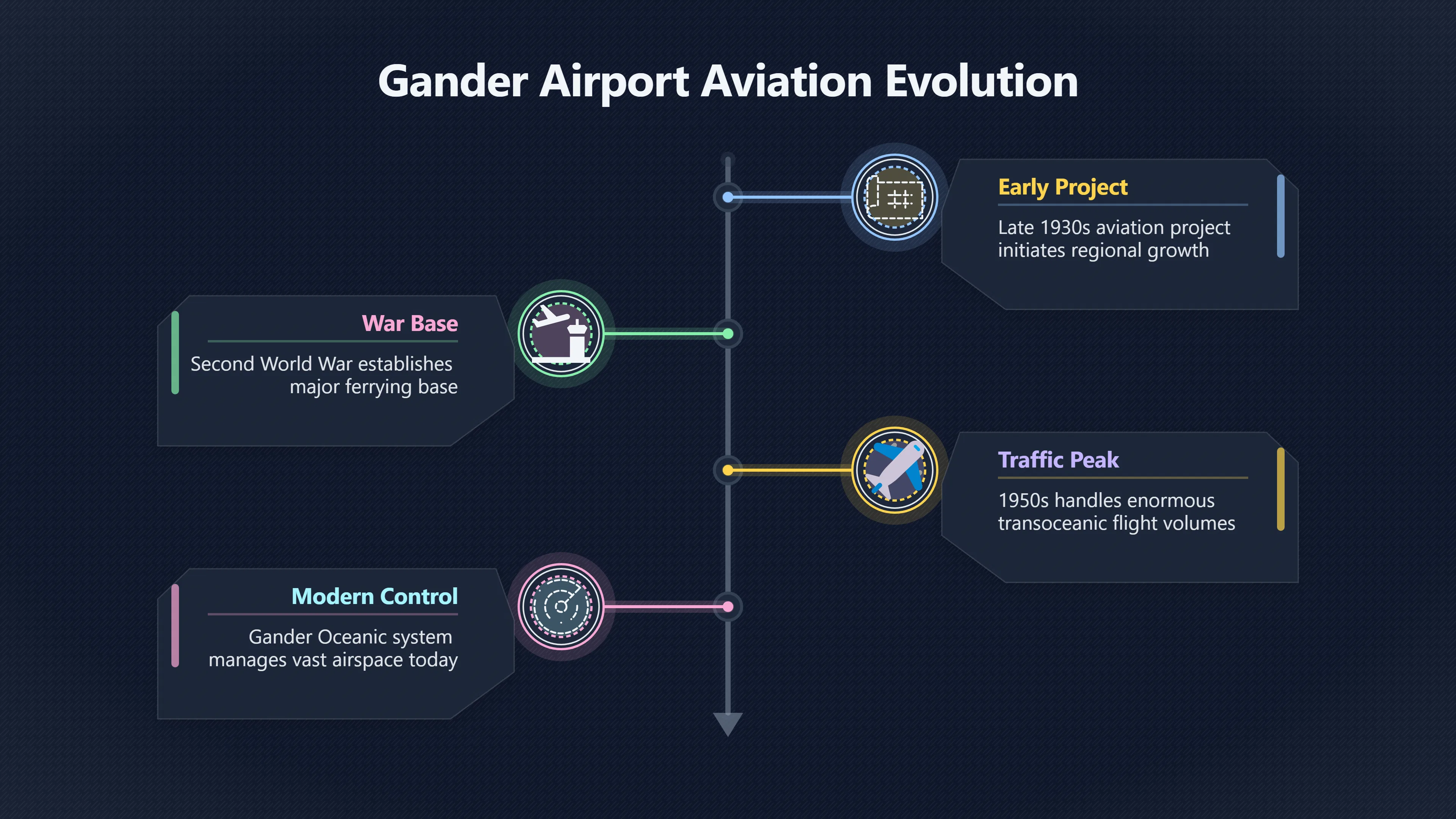
For much of the twentieth century, Gander occupied a unique position in transatlantic flight. The airport grew from a late-1930s aviation project into one of the world’s most important Atlantic staging points. During the Second World War it became a major ferrying base, and by the 1950s it was handling enormous volumes of transoceanic traffic. The airport’s reputation as the “Crossroads of the World” was not a slogan invented after the fact; it reflected its central role in North Atlantic operations. Heritage Newfoundland and Labrador+2Gander International Airport - GIAA [heritage.nf.ca]heritage.nf.cagander baseHeritage Newfoundland and LabradorGander Airport and World War IIGander's airport was the largest on the planet in 1940 and played a cruc…
This matters because aviation-linked UFO reports are often judged differently from ground sightings. Pilots are trained observers, familiar with aircraft lighting, navigation procedures and weather. However, the skies around Gander were also unusually crowded and operationally complex. Aircraft approaching, departing or crossing the Atlantic could appear at unfamiliar angles and distances, particularly at night over the ocean. [Gander International Airport - GIAA]ganderairport.comGander International Airportbuilt and opened in June 19, 1959. By the 1950s, Gander airport was one of the busiest international airports in the world, buoyed by tra…
The region’s importance continued into the modern era through the Gander Oceanic control system, which manages vast stretches of North Atlantic airspace. Even today, the area is associated with long-distance traffic moving between North America and Europe. That concentration of aviation activity helps explain why unusual aerial reports from the region deserve attention while simultaneously requiring careful scrutiny. [Fly UK Virtual Airways]flyuk.aeroFly UK Virtual AirwaysIFR North Atlantic Oceanic Flight and ATC CommunicationTraffic within the Gander Oceanic FIR is managed by the Gand…
Ordinary candidates in busy oceanic airspace
When a pilot reports a strange light over the Atlantic, several ordinary explanations must be considered before concluding that the object was genuinely unknown.
One possibility is another aircraft. Modern investigators sometimes underestimate how deceptive aircraft lighting can be at long range. A distant aircraft travelling toward an observer may appear nearly stationary for several minutes because its movement is largely along the observer’s line of sight. If its landing lights or other bright lights become visible, the object can seem to grow rapidly in brightness without appearing to move much. When the aircraft changes heading, the apparent behaviour can suddenly alter, creating the impression of an extraordinary manoeuvre.
Another possibility involves celestial objects. Bright planets, stars near the horizon and moonlit cloud formations have repeatedly appeared in aviation UFO reports. The U.S. Air Force’s Project Blue Book eventually concluded that many reported UFOs were misidentified astronomical objects or conventional aircraft rather than unknown craft. [Wikipedia]WikipediaProject Blue BookProject Blue Book
Oceanic environments add further complications. Reflections from cloud layers, haze, ice crystals and temperature inversions can distort the appearance of lights. A light seen through thin cloud may appear to change shape, colour or size. Over dark water, where there are few visual reference points, these effects can become especially convincing. The 1951 crew themselves reportedly first considered whether the light might be associated with a ship or distant settlement before concluding that it appeared airborne, illustrating how difficult identification could be under such conditions. [Wikimedia Commons]upload.wikimedia.orgWikimedia CommonsThe Project Blue Book ArchiveSeptember 9, 2005 — The Project Blue Book Archive contains tens of thousands of documents g…
Why distance and speed were so fragile
The most important lesson from the Gander-related aircrew report is not that pilots are unreliable. Rather, it is that even highly skilled observers struggle to estimate distance and speed when viewing an isolated light at night.
Human perception depends heavily on reference points. Over land, observers can compare an object’s position with roads, buildings or terrain. Over the open Atlantic, those references largely disappear. A light of unknown size at an unknown distance can seem enormous or tiny, slow or fast, depending on assumptions the observer does not realise they are making.
This becomes especially significant when witnesses describe an object approaching on a collision course. Aviation investigators have long recognised that an object travelling directly toward an aircraft can appear stationary until the geometry changes. A relatively ordinary aircraft may therefore seem to hover, suddenly accelerate or make an abrupt turn when viewed from the wrong angle. The perceived motion can be real, but the interpreted speed may be dramatically exaggerated.
The same issue affects estimates of altitude. A light seen below an aircraft may appear to climb rapidly if clouds, haze layers or changing viewing angles alter its apparent position. Without a known range, observers cannot accurately calculate its true movement.
These limitations do not mean the 1951 sighting was solved. Rather, they explain why dramatic descriptions of speed and manoeuvrability should be treated cautiously. The most reliable part of the report is that the crew saw an unusual light. The least reliable part is any estimate of how large, distant or fast that light actually was.
What this means for Newfoundland and Labrador UFO history
Within the wider UFO history of Newfoundland and Labrador, Gander occupies a distinctive place because it combines credible witnesses with an environment prone to observational error. That combination makes aviation cases from the region valuable but difficult.
The strongest argument in favour of taking such reports seriously is that they often involve trained flight crews operating in a professional setting. The strongest argument for caution is that North Atlantic airspace creates ideal conditions for misidentification: heavy air traffic, long viewing distances, night operations, changing weather and few visual references. Gander International Airport - GIAA+2Fly UK Virtual Airways [ganderairport.com]ganderairport.comGander International Airportbuilt and opened in June 19, 1959. By the 1950s, Gander airport was one of the busiest international airports in the world, buoyed by tra…
As a result, Gander-related UFO reports are best understood not as proof of extraordinary craft, nor as cases that can be dismissed outright. They are examples of how aviation uncertainty works in practice. The region’s importance to Atlantic flight ensured that unusual lights would be noticed and documented, but it also ensured that some of those lights would remain difficult to interpret decades later. Gander International Airport - GIAA+2Heritage Newfoundland and Labrador [ganderairport.com]ganderairport.comGander International Airportbuilt and opened in June 19, 1959. By the 1950s, Gander airport was one of the busiest international airports in the world, buoyed by tra…

Amazon book picks
Further Reading
Books and field guides related to Why Gander made strange lights harder to judge. Use these as the next step if you want deeper reading beyond the article.
UFOs
Directly addresses how trained aircrew report unusual aerial observations and how such cases are evaluated.
The UFO Experience
Provides frameworks for assessing aerial sightings, witness reliability, and possible misidentifications.
Fate is the Hunter
Offers insight into mid-century flight operations, navigation, weather, visual perception, and pilot decision-making.
UFOs and Nukes
Examines reports from trained military observers and the challenges of interpreting unusual aerial events.
eBay marketplace picks
Marketplace Samples
Example marketplace items related to this page. Use the search link to explore similar finds on eBay.
Endnotes
-
Source: ganderairport.com
Title: Gander International Airport
Link: https://ganderairport.com/about-giaa/our-history/Source snippet
built and opened in June 19, 1959. By the 1950s, Gander airport was one of the busiest international airports in the world, buoyed by tra...
Published: June 19, 1959
-
Source: Wikipedia
Title: Project Blue Book
Link: https://en.wikipedia.org/wiki/Project_Blue_Book -
Source: upload.wikimedia.org
Link: https://upload.wikimedia.org/wikipedia/commons/3/3b/Project_Blue_Book%2C_BBA-PBSR1-300.pdfSource snippet
Wikimedia CommonsThe Project Blue Book ArchiveSeptember 9, 2005 — The Project Blue Book Archive contains tens of thousands of documents g...
Published: September 9, 2005
-
Source: Wikipedia
Link: https://en.wikipedia.org/wiki/North_Atlantic_TracksSource snippet
North Atlantic TracksEntrance and movement along these tracks is controlled by special oceanic control centres to maintain separation...
-
Source: Wikipedia
Title: Gander, Newfoundland and Labrador
Link: https://en.wikipedia.org/wiki/Gander%2C_Newfoundland_and_LabradorSource snippet
Gander, Newfoundland and LabradorGander is a town located in the northeastern part of the island of Newfoundland in the Canadian provi...
-
Source: Wikipedia
Title: Gander International Airport
Link: https://en.wikipedia.org/wiki/Gander_International_AirportSource snippet
Gander International AirportThe airport is sometimes referred to as the "Crossroads of the World", and is classified as an internation...
-
Source: heritage.nf.ca
Title: gander base
Link: https://www.heritage.nf.ca/articles/politics/gander-base.phpSource snippet
Heritage Newfoundland and LabradorGander Airport and World War IIGander's airport was the largest on the planet in 1940 and played a cruc...
-
Source: flyuk.aero
Link: https://flyuk.aero/assets/downloads/resources/documents/online_flying/UKV_TRD_4.8_OCEANIC_FLYING_ATC_COMMUNICATION_V1_0.pdfSource snippet
Fly UK Virtual AirwaysIFR North Atlantic Oceanic Flight and ATC CommunicationTraffic within the Gander Oceanic FIR is managed by the Gand...
-
Source: ganderairport.com
Title: Arrivals and Departures
Link: https://ganderairport.com/flights/arrivals-and-departures/Source snippet
Gander International Airport - GIAAStay updated with Gander Airport Arrivals and Departures - Real-time flight information for seamless t...
-
Source: thecanadianencyclopedia.ca
Link: https://thecanadianencyclopedia.ca/en/article/ganderSource snippet
, NL, incorporated as a town in 1954, population 11880 (2021 census), 11688 (2016 census). The town of Gander is located on Gander Lake i...
Additional References
-
Source: nsa.gov
Link: https://www.nsa.gov/portals/75/documents/news-features/declassified-documents/ufo/usaf_fact_sheet_95_03.pdfSource snippet
Force regulation establishing and controlling the program for investigating and analyzing UFOs was rescinded.Read more...
-
Source: gandercanada.com
Link: https://www.gandercanada.com/recreation-activities-and-visitors/history/Source snippet
HistoryThroughout the 'Jet Age' of the '50s and '60s, virtually every transatlantic flight required a refueling stop at Gander, making Ga...
-
Source: archivesfoundation.org
Link: https://archivesfoundation.org/documents/50-years-ago-government-stops-investigating-ufos/Source snippet
National Archives Foundation50 Years Ago: Government Stops Investigating UFOsAfter investigations found no evidence of any UFO that was e...
-
Source: esd.whs.mil
Link: https://www.esd.whs.mil/Portals/54/Documents/FOID/Reading%20Room/UFOsandUAPs/proj_b1.pdf?ver=2017-05-22-113513-837Source snippet
Project Blue BookAir traffic of commercial airlines and flights of military aircraft are checked with the nearest control center, enablin...
-
Source: facebook.com
Title: during the cold war as project blue book investigated potential ufo threats a sh
Link: https://www.facebook.com/HISTORY/posts/during-the-cold-war-as-project-blue-book-investigated-potential-ufo-threats-a-sh/1473622884330683/Source snippet
Air Force's mission to its limits and became one of the most significant encounters in UFO history. #MonsterQuestDuring the Cold War, as...
-
Source: reddit.com
Link: https://www.reddit.com/r/VATSIM/comments/1j57f9i/questions_about_oceanic_airspace_and/Source snippet
need to update their position with ATC and separation standards are usually...Read more...
-
Source: archives.gov
Title: project blue book 50th anniversary
Link: https://www.archives.gov/news/articles/project-blue-book-50th-anniversarySource snippet
Public Interest in UFOs Persists 50 Years After Project Blue...5 Dec 2019 — Project Blue Book, from March 1952 to December 1969—the long...
Published: March 1952
-
Source: ops.group
Title: special report oceanic errors in the north atlantic
Link: https://ops.group/blog/special-report-oceanic-errors-in-the-north-atlantic/Source snippet
Special Report: Oceanic Errors in the North Atlantic20 Dec 2015 — ICAO has published the following recommendations to reduce oceanic erro...
-
Source: steelehotels.com
Link: https://www.steelehotels.com/blogs/top-10-things-to-do-in-gander-nl-in-summer/Source snippet
Top 10 Things to Do in Gander, NL, in SummerGander, NL, offers a diverse range of activities that cater to all interests and ages...
-
Source: reddit.com
Link: https://www.reddit.com/r/UFOs/comments/rlwdrs/original_photo_from_project_blue_book_taken_in/Source snippet
1951: r/UFOs1.5K votes, 332 comments. This photo, from the featured document display, is from a report of a UFO sighting in Riverside, C...
Topic Tree